Bedroom Furniture Sets: 58cm Wardrobes, 750mm Walkways
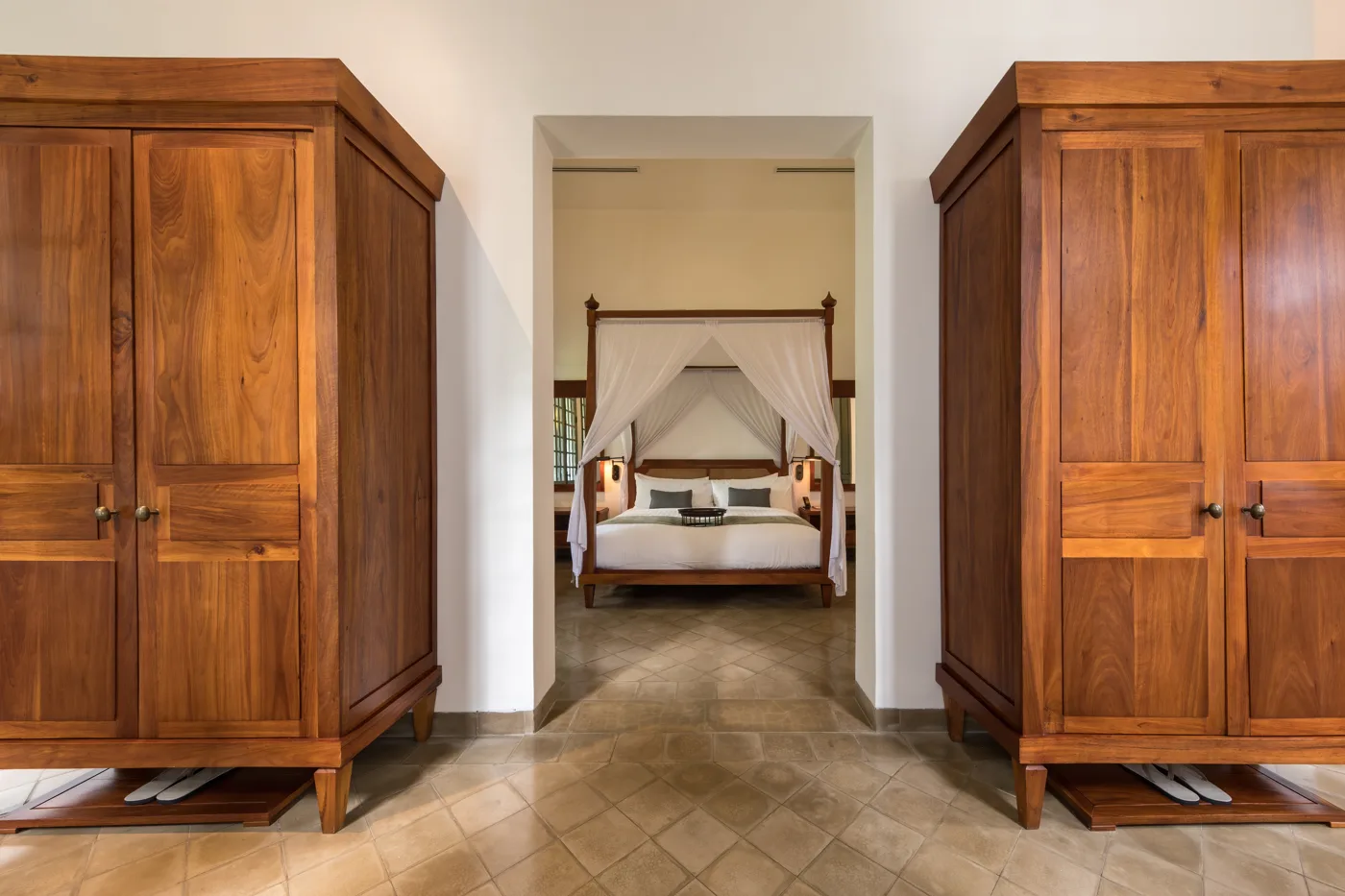
Bedroom furniture sets are sold on coordination, which is the least important thing about them. A matching bed, wardrobe, chest and pair of bedsides photographs beautifully in a showroom with three metres of clear floor in front of it. In a real British bedroom the set either fits around the door swing, the radiator and the chimney breast or it does not, and that is decided by four or five measurements that no set is ever advertised with. This is the order a designer works in: measure, then plan the walkways, then choose the look.
What is actually in a “set”, and what is not
A typical UK bedroom set is four or five pieces: a bed frame or headboard, two bedside tables, a chest of drawers, and a wardrobe, usually two-door. Some sets substitute a dressing table for the chest, and a few include a blanket box.
What is almost never included is the mattress, and that matters more than it sounds, because it is the piece with the least standardised dimensions. Nor, in most sets, is a wardrobe that is actually big enough: the standard two-door wardrobe in a five-piece set gives around a metre of hanging rail, which is one person’s clothes, not two.
The measurements that decide it
Bed size first, because everything else arranges itself around the bed. UK bed sizes are standardised, and the National Bed Federation’s advice service publishes them as:
| Size | Dimensions |
|---|---|
| Small single | 75 x 190cm |
| Single | 90 x 190cm |
| Small double | 120 x 190cm |
| Double | 135 x 190cm |
| King | 150 x 200cm |
| Super king | 180 x 200cm |
Then the walkways. The figure to plan to is 750mm. That is the clear access zone Approved Document M requires beside and at the foot of a bed in new homes built to the accessible and adaptable M4(2) standard, and it is a good minimum for any bedroom because it is roughly the width a person needs to pass a bed while carrying bedding. Below about 600mm a gap stops being a route and becomes a squeeze. Plan 750mm down at least one side and across the foot, and remember that a wardrobe door needs its own swing on top of that.
Then wardrobe depth, which is the measurement sets get wrong most often. A garment on a normal side-to-side hanging rail needs about 580mm of internal depth, which is why IKEA builds PAX in 58cm and 35cm depths and why the 35cm frames take a pull-out rail where clothes hang front-on instead. Any wardrobe sold at 45 or 50cm deep is a compromise: shoulders press against the door, and coats will not fit at all. Check the internal depth, not the carcass depth, because a moulded door and a back panel can eat 40mm between them.
Then drawer projection. A chest of drawers needs its own depth plus the full extension of the drawer, so a 450mm deep chest with full-extension runners occupies about 900mm of floor when you are using it. Put that in front of a door and the door stops opening.
Small bedrooms: change the bed, not the furniture
In a box room the usual instinct is to hunt for smaller furniture. The better move is almost always to rethink the bed, because it is the single largest object and the only one whose orientation you can change.
Three things that genuinely work in small bedroom design:
- Drop to a small double at 120 x 190cm. It is 15cm narrower than a standard double, which is often exactly the 150mm that turns an impossible layout into a workable one. Bedding is harder to find than for a 135, so check that before committing.
- Push the bed into a corner and go tall on one wall. One run of full-height storage on the shortest wall, with the bed against the long wall, beats four freestanding pieces scattered round the room. Full-height also stops the dust-collecting gap above a wardrobe.
- Buy storage inside the bed. An ottoman lift-up base or a divan with drawers replaces the chest entirely, which in a small room is the piece most worth losing. It is not a good home for everyday clothes, but it swallows bedding and out-of-season things.
What does not work is a set of five small pieces. Several small objects around the walls make a room read as cluttered and smaller than it is; the same principle as our small living room ideas, where fewer and larger reads bigger.
The set-versus-pieces question
The honest answer is that sets are bought for the wrong reason and are still sometimes right.
Where a set earns its place: when the room is a guest room or a rental, where coherence matters more than perfection; when you genuinely need everything at once and the timber finish would be difficult to match across brands; and when the set’s own wardrobe happens to be a proper 58cm deep.
Where pieces win: when you want one good wardrobe and are happy for the bed to be different; when you are buying over time; and when the set’s weak piece is the one you will use most. A useful rule is to buy the wardrobe on its merits alone and let the smaller pieces follow it, because a bad wardrobe irritates you every day and a mismatched bedside does not.
The trap either way is the discontinued range. Furniture ranges are refreshed on a two to three year cycle, so the matching second chest you plan to add later frequently no longer exists. If your plan depends on extending the set, buy the extra piece now or accept that you will be mixing.
Materials: read the description twice
“Solid oak” in a set description often means solid oak on the parts you touch and oak-veneered board everywhere else, which is not a scandal but is a different price of thing. The words that tell you what you are getting:
- Solid timber throughout is heavy, repairable and expensive, and moves slightly with humidity.
- Veneered MDF or chipboard is what the bulk of sets are, and is perfectly serviceable. The quality signal is the thickness of the board and the edging: an 18mm carcass with a proper edge band lasts; a 12mm back stapled on does not. The same board logic we set out in our kitchen carcass guide applies to bedroom furniture.
- Drawer runners are the cheapest place to cut cost and the first thing to fail. Metal soft-close runners on full extension are worth paying for; plastic side runners on a wooden drawer are a sign of where else the money was saved.
- Wardrobe backs and bases matter for a piece that carries weight. A 3mm hardboard back nailed into the edges will rack over time; a rebated back panel will not.
Two compliance details worth knowing
Look for the BS 7177 label. Mattresses, divans and bed bases carry their fire-safety labelling under BS 7177 rather than the permanent label required on other upholstered furniture, and it should be attached to the item when it arrives. Duvets, pillowcases and loose mattress covers are outside the regulations. An unlabelled mattress from a marketplace seller is a red flag, not a bargain.
Mattresses are allowed to be the wrong size. The National Bed Federation states plainly that there is no legal standard on size tolerances for mattresses and divan bases in the UK, and that accepted industry practice is plus or minus 20mm on the advertised length and width. So a mattress bought separately from a bed frame can be up to 20mm out in either direction. On a slatted frame with a lipped surround that is the difference between a snug fit and a mattress that will not drop in.
Before you order, do this
Draw the room on paper at 1:50 with the door swing, window, radiator, sockets and any chimney breast marked, then cut the furniture out to scale and move it about. It takes twenty minutes and it catches every mistake described above.
Then check the route in. A two-door wardrobe delivered assembled is typically over 2m tall and 1m wide as one rigid object, and a Victorian stair turn will not take it. Flat-pack solves that and costs you assembly time; a fitted wardrobe solves it properly and costs more. Our cost per room guide sets out where bedroom budgets usually go, and green bedroom ideas covers the finish decisions once the layout works.
Frequently asked questions
What is usually included in a bedroom furniture set? Most UK sets are four or five pieces: a bed frame or headboard, two bedside tables, a chest of drawers and a two-door wardrobe. The mattress is almost never included, and the wardrobe is usually the weakest piece, giving around a metre of hanging rail.
How much space do you need around a bed? Plan 750mm of clear floor down at least one side and across the foot. That is the clear access zone Approved Document M sets for bedrooms in new homes built to the M4(2) accessible standard, and wardrobe and chest doors need their opening space on top of it.
How deep should a wardrobe be? About 58cm internally for a standard side-to-side hanging rail, which is why IKEA’s PAX frames come in 58cm and 35cm depths. A 35cm wardrobe needs a pull-out rail with clothes hung front-on, and anything advertised at 45 to 50cm deep will crease shoulders and will not take coats.
Are bedroom furniture sets worth buying? They are worth it for guest rooms, rentals and rooms you are furnishing all at once, especially where matching a timber finish across brands would be difficult. If one piece will do most of the work, buy that piece on its own merits instead, because ranges are discontinued every two to three years and the matching piece you plan to add later may not exist.
What is the best bed for a small bedroom? A small double at 120 x 190cm, pushed into a corner, with one wall of full-height storage rather than several small freestanding pieces. An ottoman or drawer base then replaces the chest of drawers, which is the piece most worth losing in a box room.
Is solid wood bedroom furniture better than MDF? It is more repairable and holds its value, but good veneered board is entirely adequate and most sets are made of it. Judge the piece by the carcass thickness, the edge banding, the drawer runners and how the back panel is fixed, rather than by the word used in the description.
The Folio
Want more like this in your inbox?
One considered idea for your London home, every Thursday.
SubscribeMore from KDS London
All guides
How Much Does an Interior Designer Cost in London in 2026?
What interior designers charge in London in 2026: hourly rates, day rates, per-room fees and percentage models, with real figures and what each one buys you.
Read
Navy Kitchen Ideas: Blue, Teal and Cobalt Cabinet Designs
Navy kitchen ideas that work: the best blue cabinet shades, worktop and hardware pairings, and how to use navy, teal and cobalt without dating the room.
Read
Gold and Brass Bathroom Accessories: How to Style Warm Metallics
How to choose and style gold bathroom accessories and brass fittings, from brushed vs polished finishes to mixing metals and avoiding tarnish.
Read