Kitchen Carcass Specs: That Wall Shelf Holds 15kg
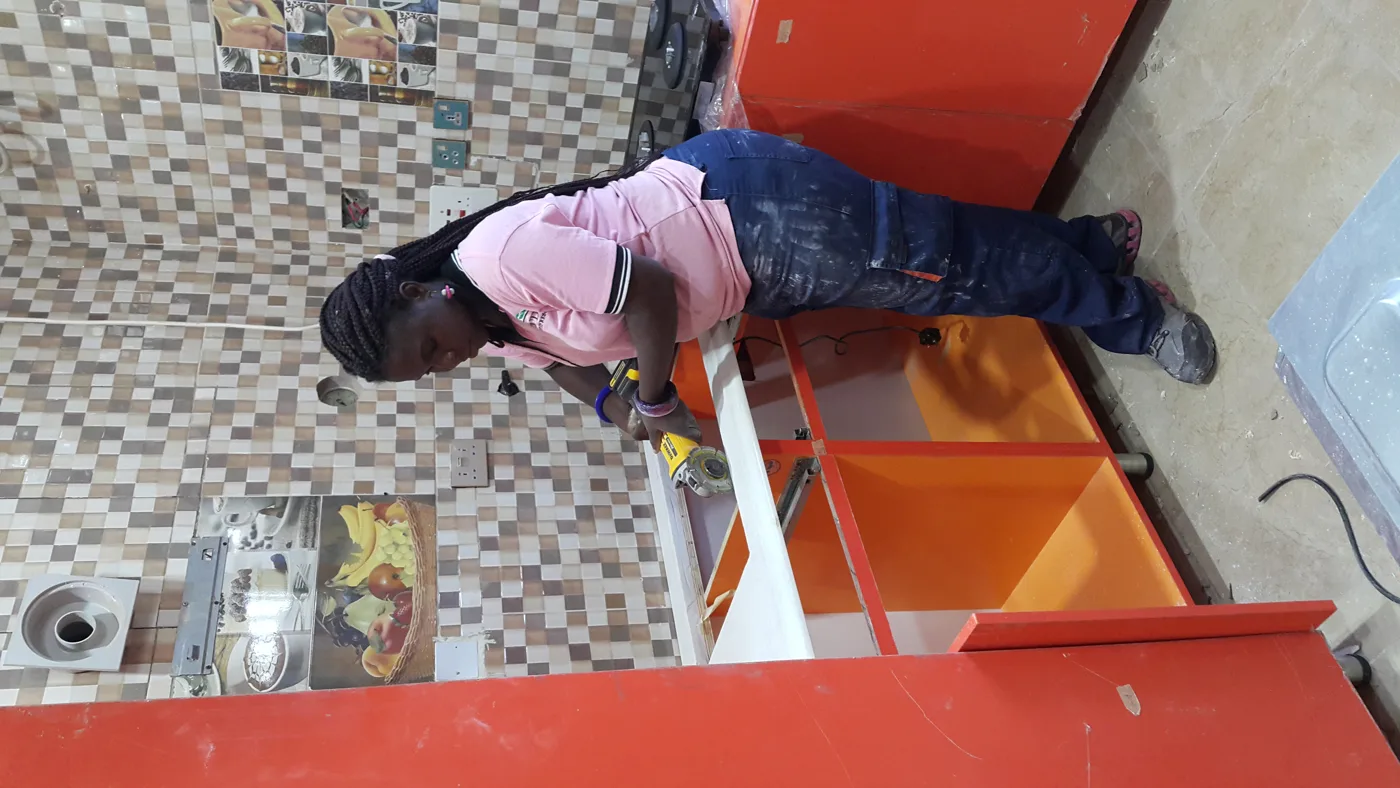
Here is a number that stops most kitchen conversations. Howdens publishes a weight sheet for its rigid cabinets, and the recommended daily shelf loading for a full-height wall cabinet is 15kg. That is a sustained load, on one shelf. Roughly three dozen 400g tins, or a stack of everyday crockery and not much else. Nobody mentions it in a showroom.
That figure exists because a kitchen carcass is a structural component, and it is the one part of a kitchen you buy once. Doors get replaced, worktops get replaced, handles get swapped in an afternoon. The boxes stay in the room for as long as the kitchen does. Which makes it strange that carcass specification is the thing almost nobody compares, while everyone compares door colours.
This page is what the spec sheets actually say. Every figure below is from a manufacturer’s own published document.
What a kitchen cabinet carcass actually is
A carcass is the box: two side panels, a base, a back, a top rail or full top, shelves, and the hardware that holds it square. It carries the worktop, it carries whatever you put on the shelves, and in the case of a wall unit it carries all of that off a plasterboard wall.
The important consequence is that carcass quality is not cosmetic. When a kitchen “looks tired” after ten years, it is usually the doors and worktop. When a kitchen actually fails, it is the carcass: a wall unit sagging away from the wall, a sink base swollen at the bottom, a run that has racked out of square so the doors no longer line up. Those are all carcass problems and none of them are fixable with paint. If your kitchen is only cosmetically tired, painting the cupboards is a genuine option and the carcasses stay put.
The five numbers that matter on a spec sheet
1. Panel thickness on kitchen unit carcasses
18mm melamine faced chipboard, usually written MFC, is the mainstream UK standard for side panels, base panels and shelves. Both Howdens and DIY Kitchens publish 18mm. If a supplier is quoting 15mm sides, that is a step down and it should show up in the price. Thickness matters most for shelf deflection over a wide span and for how well a dowel joint holds.
2. The back panel, which is where the real difference is
This is the number to ask for, because it varies enormously and it is the panel that stops a cabinet racking into a parallelogram.
Howdens states 3mm HDF back panels on wall cabinets and 6mm HDF on base and tower cabinets, the thicker board specifically “for increased strength and rigidity”. DIY Kitchens states 8mm melamine faced chipboard backs on both wall and base units.
So on the same 18mm carcass, the back can be 3mm, 6mm or 8mm depending on who you buy from. A thin back panel pinned into a groove is doing far less work than an 8mm board. It is the cheapest place for a manufacturer to save money and the hardest place for a customer to notice.
3. Edging
Front edges take every knock, every wet cloth and every trolley of shopping. DIY Kitchens uses 2mm PVC on the front edges and 0.4mm tape on other exposed edges. Howdens uses ABS or PP edging on its 18mm panels. The pattern to watch for is thin melamine tape on a front edge: it chips, and once it chips the chipboard underneath is open to water.
4. Construction, and whether it arrives built
Both of the suppliers above use glue and dowel construction and both ship rigid, meaning the box arrives already assembled. The alternative is flat pack, where you build the box on site, usually with cam locks. Cam-and-dowel flat pack is not automatically bad, and it is much easier to carry up a London staircase, but a glued dowel joint is permanently rigid in a way a cam lock is not, and it cannot be over-tightened by whoever is building it at four in the afternoon.
5. Board grade, which almost nobody publishes
Particleboard is graded under EN 312. P2 is furniture-grade board for dry conditions. P3 is the non-load-bearing moisture-resistant grade intended for humid conditions, and it is the grade you would want anywhere near a sink or a dishwasher.
Here is the finding. Neither of the two spec sheets quoted above names a grade at all. They give thickness, facing, edging and construction, and stop. If moisture resistance matters to you, and in a kitchen it does, you have to ask the question directly and get the answer in writing, because it is not on the published spec.
What the two published specs look like side by side
| Spec | Howdens rigid cabinet | DIY Kitchens |
|---|---|---|
| Side, base and shelf panels | 18mm MFC | 18mm MFC (Egger) |
| Wall unit back panel | 3mm HDF | 8mm MFC |
| Base unit back panel | 6mm HDF | 8mm MFC |
| Front edging | ABS or PP | 2mm PVC |
| Other exposed edges | not stated | 0.4mm tape |
| Construction | glued and dowelled, ready assembled | glue and dowel, supplied rigid |
| Base or tower depth | 575mm | wall units 300mm deep excluding door |
| Leg adjustment | 143mm to 188mm, cuttable to 90mm minimum | 150mm standard, 100mm optional, minus 10mm to plus 20mm |
| Published testing | BS EN 14749:2016, BS6222:2009 Part 2 Level H, BS6222:2017 Part 3, FIRA Gold | not stated |
| EN 312 board grade | not stated | not stated |
Two honest caveats. This is a comparison of what each company chooses to publish, not a laboratory test, and a spec that is “not stated” may still exist. But published specification is the only thing you can hold a supplier to, and the fact that one of them publishes a testing regime and the other does not is itself information.
BS EN 14749 is “Domestic and kitchen storage units and worktops: safety requirements and test methods”. BS 6222 is the British Standard series for domestic kitchen equipment. A supplier citing them by number and edition is telling you the cabinets have been through a defined test, which is a materially different claim from “high quality”.
The load figures you were never given
Howdens publishes maximum weight information for its rigid cabinets, and it is the most useful page in the whole document.
| Wall cabinet (1000mm) | Base cabinet (1000mm) | |
|---|---|---|
| Recommended daily cabinet loading | 66kg | 65kg |
| Recommended daily shelf loading, sustained | 15kg | 27kg |
| Mid shelf overload test weight, held one week | 42kg | 73kg |
Read the shelf rows, not the cabinet rows. A wall cabinet shelf is rated at 15kg for sustained daily use, and a base cabinet shelf at 27kg. Wall units are the weak point by a wide margin, which makes sense: everything they hold is hanging off wall fixings rather than standing on legs. Howdens is explicit that the wall figures assume suitable fixings for the wall structure, which in a flat with dot-and-dab plasterboard is a real question and not a formality.
The practical rule that falls out of this: heavy things go low. Tinned food, casserole dishes, the stand mixer, the dinner service, all of it belongs in base units or a larder unit, not in a wall cupboard. Wall cupboards are for light, bulky, frequently used things. Most kitchens are loaded the other way round because wall units are at eye level and feel more convenient.
Two more figures from the same sheet, both useful when planning: base cabinets are 720mm high excluding feet and 890mm including them, and there is a 72mm service void at the back of a base cabinet for pipework. That service void is why a base run sits proud of the wall, and it is the reason a plan drawn to 575mm cabinet depth still needs about 600mm of floor. Our cabinet dimensions guide covers the rest of the standard sizes.
The unit that fails first
It is always the sink base. Water gets past a sealant bead or a leaking waste, sits on the base panel, and chipboard swells irreversibly. This is precisely where EN 312 P3 board earns its keep and precisely where nobody publishes the grade.
Two things to insist on. First, ask whether the sink base has a removable back panel: Howdens notes that its dedicated sink base cabinets are a different design with one, which makes a leak reachable rather than a demolition job. Second, treat the base panel of the sink unit as a consumable and check it once a year. A dark stain along the front edge of a sink base is early warning, not decoration.
Rigid or flat pack
Rigid cabinets arrive built. The joints were glued and clamped in a factory rather than assembled on a floor, they are square from the outset, and installation is faster. The costs are delivery volume and the fact that a 1000mm base unit cannot be carried up a narrow Victorian staircase in a box.
Flat pack costs less to buy and to deliver, and for a small kitchen or an awkward access it can be the only sensible route. What you give up is joint quality consistency. If you go flat pack, glue the dowels even where the instructions do not tell you to, and fix every unit to the wall and to its neighbours before the worktop goes on. A run of flat-pack boxes screwed together along their front edges behaves far better than the same boxes standing apart.
What to ask before you buy
Five questions, and any supplier worth using can answer all five without checking:
- What thickness is the back panel on a wall unit, and on a base unit?
- Is the board EN 312 P2 or P3, and is the sink base different from the others?
- Is the front edging 2mm, and what is on the other exposed edges?
- Are the cabinets tested to BS EN 14749 and BS 6222, and to which edition?
- What is the recommended sustained shelf load on a wall unit?
If the answers are vague, that is the answer. Carcasses are the part of a kitchen that a good supplier is happy to be specific about, because specificity is where the money went. When you are working out where a kitchen budget goes, our new kitchen cost breakdown and the base units guide are the natural next reads, and if you are planning drawers rather than cupboards the drawer units guide covers the load ratings that apply there instead.
Frequently asked questions
What is a kitchen carcass? It is the structural box of a kitchen unit: side panels, base, back panel, shelves and the hardware holding it square. The door, drawer front, worktop and handles are separate. In UK kitchens the carcass is normally 18mm melamine faced chipboard, supplied either ready assembled or flat pack.
How thick should a kitchen carcass be? 18mm is the mainstream UK standard for sides, base and shelves, and both Howdens and DIY Kitchens publish 18mm. The more revealing number is the back panel, which ranges from 3mm HDF on some wall units up to 8mm MFC, and the back panel is what stops a cabinet racking out of square.
Can you replace kitchen doors and keep the carcasses? Yes, and it is one of the better value decisions in a kitchen refit, provided the carcasses are sound, square and the right size. Check for swelling at the sink base, sagging wall units, and whether the existing units are standard widths. If the boxes were 15mm or the backs are thin and already loose, replacing the doors puts new fronts on a failing structure.
How much weight can a kitchen wall cabinet hold? Howdens publishes 66kg recommended daily loading for a 1000mm wall cabinet, with a recommended sustained shelf loading of 15kg per shelf, assuming fixings suited to the wall. Base cabinets are rated at 65kg for the cabinet and 27kg per shelf. Heavy items belong in base units.
Is P3 moisture-resistant board worth paying for in a kitchen? Near water, yes. EN 312 P3 is the moisture-resistant non-load-bearing grade intended for humid conditions, where P2 is a dry-conditions furniture grade. The catch is that mainstream UK suppliers do not publish the grade on their spec sheets, so it is a question to ask directly and get answered in writing, particularly for the sink base.
Are rigid carcasses better than flat pack? Rigid boxes are glued, dowelled and clamped in a factory, so they arrive square and stay square, and they install faster. Flat pack costs less and fits through tight access. The gap closes considerably if flat-pack units are glued properly and screwed to each other and to the wall before the worktop is fitted.
Which kitchen unit fails first? The sink base, essentially always, and by water rather than by load. A slow leak from a waste or a failed sealant bead sits on the base panel and swells the chipboard permanently. A sink base with a removable back panel makes that leak reachable, which is worth asking about before you order.
The Folio
Want more like this in your inbox?
One considered idea for your London home, every Thursday.
SubscribeMore from KDS London
All guides
How Much Does an Interior Designer Cost in London in 2026?
What interior designers charge in London in 2026: hourly rates, day rates, per-room fees and percentage models, with real figures and what each one buys you.
Read
Navy Kitchen Ideas: Blue, Teal and Cobalt Cabinet Designs
Navy kitchen ideas that work: the best blue cabinet shades, worktop and hardware pairings, and how to use navy, teal and cobalt without dating the room.
Read
Gold and Brass Bathroom Accessories: How to Style Warm Metallics
How to choose and style gold bathroom accessories and brass fittings, from brushed vs polished finishes to mixing metals and avoiding tarnish.
Read