Interior Designer Trade Discount: Who Keeps It?
An interior designer trade discount is real money, usually somewhere between 10 and 40 per cent off retail, and on a London sitting room it can be worth more than the designer’s fee. What almost no one tells you before you sign is that the discount does not automatically belong to you. Depending on how your designer works, it might be passed to you in full, split with you, or kept entirely as their income while you are billed at full retail. All three are legal. Only one of them is what most clients assume is happening.
This page explains how trade pricing works, shows what each model costs on the same room, and gives you the questions that settle it before any money moves.
What a trade discount actually is
Furniture, fabric, lighting and paint brands run trade accounts for designers, architects and contractors. The designer applies, proves they are a business, and gets access to a trade price list. Buy through that account and you pay less than the public does.
Three things about that price that catch people out.
It is quoted excluding VAT. Retail prices you see on a website include VAT at 20 per cent. Trade prices almost never do. A sofa at £2,100 trade against a £3,600 retail price looks like a 42 per cent saving. Add the VAT back and the trade price is £2,520, so the real saving is 30 per cent. Always compare like with like or you will overestimate the benefit by a fifth.
The discount varies enormously by category. Trade-only brands, the ones with no shop and no public price, tend to give the deepest discounts because retail markup was never in their model. High street brands with their own showrooms give the least, because your designer is competing with their own shop. Paint is usually the thinnest of all.
It is rarely published. Suppliers treat trade terms as confidential, and a designer who has bought from a brand for fifteen years may be on better terms than one who opened the account last month. Anyone quoting you a single industry-wide figure is guessing.
The three models, and what each one costs
Here is the same London sitting room specification under all three. Retail prices include VAT, trade prices are shown with VAT added back so the comparison is honest.
| Item | Retail, inc VAT | Trade discount | Trade, inc VAT |
|---|---|---|---|
| Sofa | £3,600 | 30% | £2,520 |
| Pair of armchairs | £2,400 | 30% | £1,680 |
| Rug | £1,200 | 20% | £960 |
| Curtains, fabric and making | £2,800 | 35% | £1,820 |
| Lighting | £1,500 | 25% | £1,125 |
| Paint | £500 | 15% | £425 |
| Total | £12,000 | £8,530 |
That is £3,470 of discount on one room. Now watch what happens to your total bill depending on who keeps it.
| Model | You pay for goods | Design fee | Your total |
|---|---|---|---|
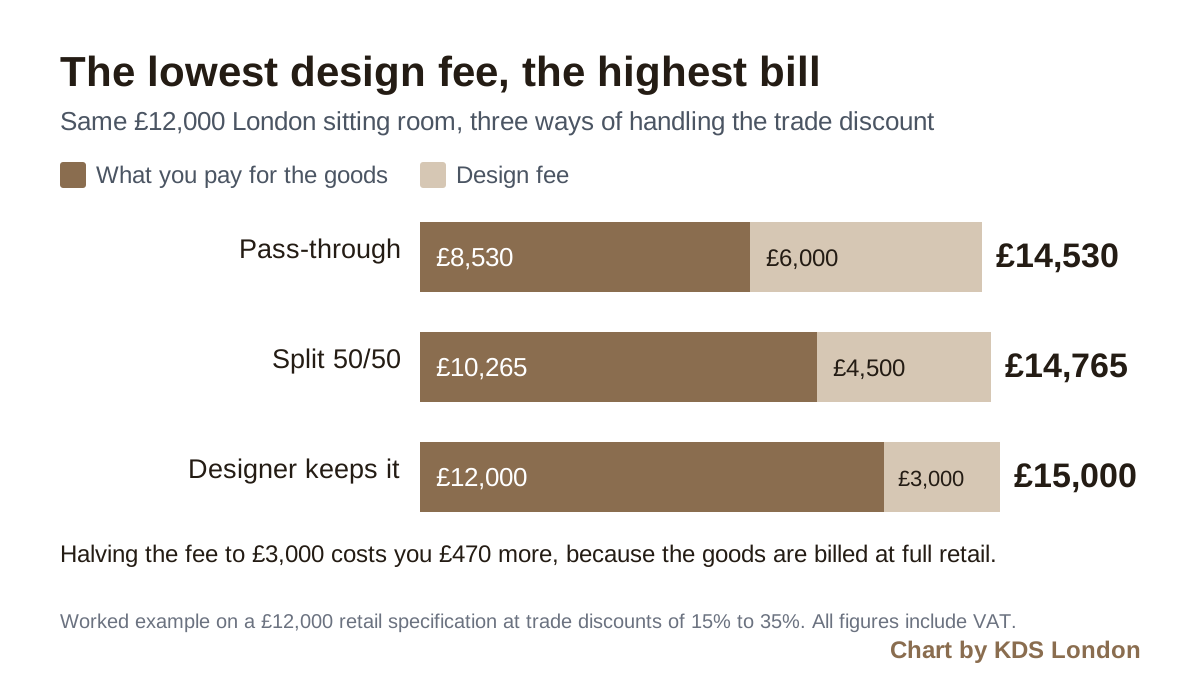
| Full pass-through | £8,530 | £6,000 | £14,530 |
| Designer keeps the discount | £12,000 | £3,000 | £15,000 |
| Split 50/50 | £10,265 | £4,500 | £14,765 |
The designer charging the lowest fee produces the highest bill. That is the single most useful thing on this page. A £3,000 fee that comes with full retail pricing is more expensive than a £6,000 fee that comes with trade pricing, and the gap grows with the size of the specification. On a whole house it is tens of thousands.
None of this makes the middle row dishonest. A designer who works on retail pricing and a modest fee has simply chosen to take their income through procurement instead of through hours, and plenty of good designers work that way. It becomes a problem only when you were not told, because then you cannot compare quotes at all. Our guide to interior designer fees covers the fee side in detail, and interior designer cost in London has current London rates.
What the rules actually require
The interior design industry is not regulated the way architecture or surveying is. Anyone can call themselves an interior designer. But two things do bite.
Professional codes. The BIID Code of Conduct, in force from 1 April 2026, requires members to have a written agreement with the client that states how the fee is calculated and how it is collected, to produce clear records of purchases, expenses and fees on request, and not to accept payments or benefits that could reasonably be perceived to impair their impartiality. BIID’s guidance on conflicts of interest names the specific practice it objects to: a designer invoicing a supplier for a handling fee or introductory fee they have not told their client about, which BIID notes may also be illegal. The institute has run a campaign against it under the name Kick out the Kick Backs.
Note what this does and does not say. Keeping a trade discount is not banned. Hiding it, or taking a payment from a supplier that quietly steers your specification, is the problem.
Consumer law. The Digital Markets, Competition and Consumers Act 2024 came into force on 6 April 2025 and let the Competition and Markets Authority enforce consumer law directly, with fines up to 10 per cent of worldwide turnover. Its first substantive decision, in April 2026, fined the AA £4.2 million and ordered over £760,000 in refunds to more than 80,000 learner drivers, all over a mandatory £3 booking fee that was not shown in the advertised price.
A £3 fee. The direction of travel on undisclosed mandatory charges could not be clearer, and a design practice quoting a fee while silently taking a second income from your purchases is standing in exactly that weather.
If you are a designer reading this, the fix is a sentence in your contract. If you are a client, the fix is asking for it.
Five questions to ask before you sign
Ask all five in writing, in one email, before contracts. A straight practice will answer in a paragraph. A defensive answer is the answer.
- Do you buy at trade prices, and do I pay trade or retail? The whole thing in one question.
- If I pay trade, how is your time charged instead? There should be a clear alternative. If the fee did not go up when the goods got cheaper, check where the money is coming from.
- Do you add a procurement or handling charge on top, and at what percentage? Common and perfectly reasonable, typically applied to the value of goods ordered. It just needs to be named.
- Do you receive any payment, rebate or commission from suppliers you specify? This is the kickback question. The answer should be no, or a full list.
- Will the invoices show the supplier’s actual price? If yes, everything above is verifiable. If no, ask why not.
Get the answers into the written agreement, not just the email thread. The RIBA/BIID client contracts exist for this and a practice that uses them has already done the work.
When trade pricing genuinely saves you money
Be realistic about where the benefit is.
It is largest on soft furnishings and bespoke work, especially curtains, blinds and upholstery, where the fabric discount is deep and the making is priced separately. It is large on trade-only brands you could not buy from at all without an account, which is often the real value: access rather than price.
It is smallest on mainstream retail furniture that is frequently discounted anyway. If a designer specifies a sofa that goes into a 25 per cent sale twice a year, a 30 per cent trade discount is worth almost nothing to you. It is smallest of all on paint and standard building materials, where the trade margin is thin.
And it is worth nothing at all on anything you were never going to buy. The most expensive room is the one where a discount talked you into more furniture than the room needed. Set the budget first, in the interior design budget planner, and treat the discount as a way to buy better within it rather than a reason to buy more.
The short version
Trade discounts are a normal, legitimate part of how design practices work. The number is usually 10 to 40 per cent, it is quoted without VAT, and it varies by brand and by how long your designer has held the account. Who keeps it is a commercial choice, not a rule, and it changes your total bill more than the headline fee does. Ask the five questions, get the answer in the contract, and compare quotes on the total, never on the fee.
Frequently asked questions
Do interior designers have to pass on their trade discount? No. There is no law or professional rule requiring it. What professional codes require is disclosure: the written agreement must make clear how the designer is paid, and the BIID Code of Conduct in force from April 2026 requires records of purchases and fees to be produced on request. Keeping the discount is allowed. Concealing it is the issue.
How much is an interior designer trade discount worth? Typically 10 to 40 per cent off retail, varying by category and supplier. On the £12,000 sitting room specification above it came to £3,470. Deepest on fabric and trade-only furniture brands, thinnest on paint and on high street names that discount themselves anyway.
Can I use my designer’s trade discount to buy something myself? No, and you should not ask. Trade accounts are issued to a business on the condition that it is the buyer, and using one to supply a consumer directly usually breaches the supplier’s terms and can get the account closed. What a designer can do is buy on your behalf and invoice you, which is the pass-through model.
Is a procurement fee the same as a trade discount? No, they are opposite sides of the same transaction. The trade discount is what the supplier takes off. A procurement or handling fee is what the designer adds on for the work of specifying, ordering, tracking and resolving deliveries, usually a percentage of the goods value. A practice can apply both, which is fine if both are written down.
What if my designer will not tell me whether they take a discount? Treat it as a decision, not an oversight. You are entitled to know what you are paying for before you commit, and a practice unwilling to put its payment structure in writing is telling you something useful. Ask again in writing, and if the answer does not come, get a quote from someone else. Our guide to hiring an interior designer in London covers what a proper written proposal should contain.
Does a trade discount apply to labour as well as goods? Generally no. Trade pricing sits on products: furniture, fabric, lighting, tiles, paint. Installation, building work, curtain making and electrical work are quoted by the trades doing them and are not usually discounted through a designer’s supplier accounts. When you see a “trade price” on a fitted kitchen, check carefully how much of that quote is goods and how much is fitting. Our new kitchen cost page breaks that split down.
Sources
The Folio
Want more like this in your inbox?
One considered idea for your London home, every Thursday.
SubscribeMore from KDS London
All guides
How Much Does an Interior Designer Cost in London in 2026?
What interior designers charge in London in 2026: hourly rates, day rates, per-room fees and percentage models, with real figures and what each one buys you.
Read
Navy Kitchen Ideas: Blue, Teal and Cobalt Cabinet Designs
Navy kitchen ideas that work: the best blue cabinet shades, worktop and hardware pairings, and how to use navy, teal and cobalt without dating the room.
Read
Gold and Brass Bathroom Accessories: How to Style Warm Metallics
How to choose and style gold bathroom accessories and brass fittings, from brushed vs polished finishes to mixing metals and avoiding tarnish.
Read