Kitchen Interior Design Cost in London: Budget vs High-End
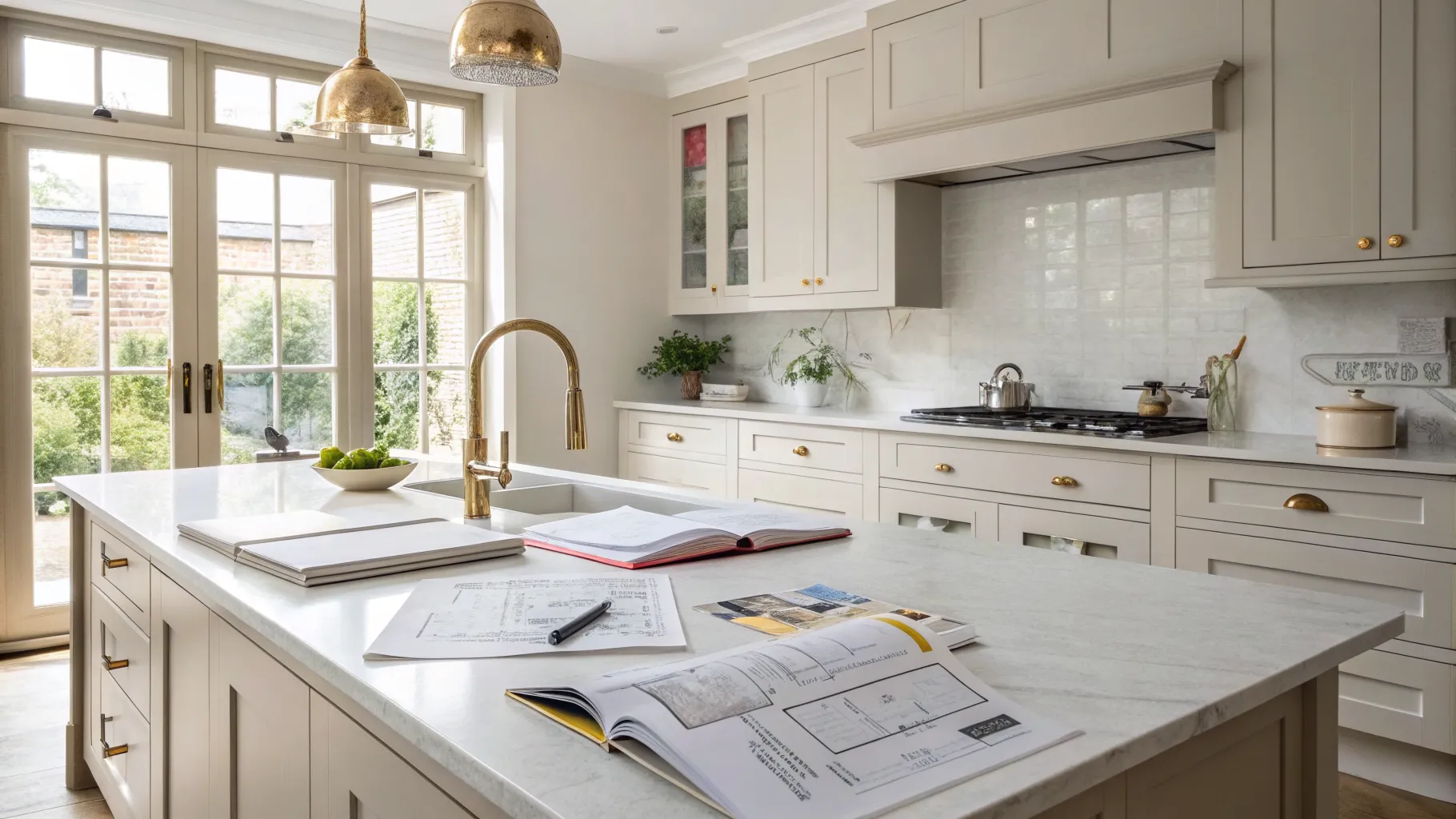
Most London kitchen quotes blur two very different numbers together: the fee you pay someone to design the kitchen, and the much larger sum you pay for the units, worktops, appliances and trades that build it. Showroom and fitter pages tend to quote the build total and call it “the cost of a kitchen”, which makes the design fee invisible. This page separates the two cleanly, so you can see what the design work actually costs, where the rest of the money goes, and how a budget refurbishment differs from a high-end or bespoke project in London.
Designer vs kitchen planner: two different costs
The first thing to settle is who you are paying.
A kitchen planner at a showroom (Howdens, Wren, a Magnet branch) usually produces a CAD layout for free, because the plan is a sales tool for that brand’s units. It is genuinely useful, but it is tied to their range and their pricing.
An interior designer designing a kitchen charges a fee for independent design work: space planning, material and finish selection, lighting and electrical layouts, joinery specification, and coordination of trades. They are not selling you one manufacturer’s cabinets, so the advice is led by your room and brief rather than a catalogue. That independence is what the fee buys.
This page is about the second kind of cost, the design fee, set in the context of the total project so you can judge whether it is proportionate.
How designers charge for a kitchen
The chartered profession’s own body sets out the common fee models. The British Institute of Interior Design’s survey of members found that 51% use a combination of methods, 21% a fixed fee, 18% hourly and 6% a percentage of the project. On hourly rates, 59% of designers charge up to £75 an hour and 41% charge between £76 and £150. Percentage fees, where used, typically land between 6% and 20% of the project value. You can read the breakdown on the BIID’s guidance on pricing a project.
For a kitchen specifically, a design fee in the region of 10% to 20% of the renovation budget is common. On a mid-range London kitchen, that puts the design portion in the low-to-mid four figures rather than five. Our interior design cost per room page gives the kitchen-specific band, and how interior designer fees work explains the fixed, hourly and percentage models in plain English.
One practical point worth asking about up front: many designers fold the initial consultation or concept fee into the project if you go ahead, so the early design spend is not always money on top.
Budget vs high-end: the whole project
Here is where the design fee sits within the total. The tiers below describe London kitchens by scope. Treat them as relative bands, not a fixed price list, and use the calculator further down to put numbers against your own job.
| Tier | What it covers | Where it sits | Design fee approach |
|---|---|---|---|
| Cosmetic refresh | New doors, worktop, splashback, paint; existing layout kept | Lowest spend | Smaller, often a fixed concept fee |
| Mid-range full renovation | New units, worktops, appliances, full trades, some layout change | Middle of the range | Percentage on the build, low-to-mid four figures |
| High-end renovation | Premium units, stone worktops, integrated appliances, lighting design | Upper range | Percentage, mid four figures and up |
| Luxury bespoke | Hand-made joinery, large island, top appliance suite, full project management | Top of the scale | Percentage plus project management on the largest jobs |
For a smaller kitchen (under roughly 8m2), every band shifts down, because there is less cabinetry, less worktop and less labour. The design effort, though, does not shrink in proportion: a small, awkward London galley can take as much planning as a large open-plan room, which is why fixed concept fees often suit compact kitchens better than a strict percentage.
To model your own numbers, the London renovation cost calculator lets you flex the build figures by tier.
Where the build money goes
On a typical mid-range London kitchen, the spend splits roughly like this:
| Element | Share of build |
|---|---|
| Cabinetry | 35% to 45% |
| Appliances | 15% to 20% |
| Labour (fitting, plumbing, electrics) | 20% to 25% |
| Worktops | 10% to 15% |
| Flooring | 5% to 8% |
| Lighting and electrical | 3% to 5% |
| Splashback and tiling | 3% to 5% |
Cabinetry is almost always the biggest single line, which is why the choice between flat-pack, rigid carcass and bespoke joinery moves the total more than anything else. This is also where an independent designer can earn the fee back: specifying the right level of joinery for your room, rather than over- or under-spending on units, often saves more than the design costs.
If your designer buys units, appliances or worktops on your behalf at trade prices, the markup arrangement matters. Our designer procurement markup calculator shows how trade discount and markup interact, so you can see whether procurement through the designer works in your favour.
Worktops, by material
Worktops are the line buyers most often get wrong, because the price spread between materials is wide. For a fitted run of roughly 4 to 5 linear metres in London, the materials sit in this rough order of cost:
- Laminate: the most economical, lowest end of the range.
- Solid wood: a step up, warm but needs maintenance.
- Quartz: a popular mid-to-upper choice, hard-wearing and consistent.
- Granite and marble: natural stone, with a wide range depending on the slab.
- Porcelain: thin, hard-wearing, towards the upper end.
- Stainless steel: a professional look, upper-mid range.
Quartz tends to be the default for London renovations because it is hard-wearing and consistent, but a designer will match the worktop to how you actually cook and to the cabinetry, not just to a price band.
Labour in London
London trade day rates run above the national average, which is the main reason the capital sits roughly 20% to 35% above the UK average for like-for-like kitchen work. Multiply higher day rates across a multi-week fit and labour becomes a serious share of the total. A kitchen fitter, plumber and electrician each command a premium in London compared with the rest of the country, so always get the labour broken out of a quote rather than buried in a single figure.
A realistic timeline: a cosmetic refresh runs 4 to 8 weeks, a mid-range renovation 8 to 15 weeks, and a high-end or bespoke kitchen anywhere from 14 to over 30 weeks once you include design and cabinet manufacture. On site, the build itself is often 2 to 4 weeks; the longer figures come from the design and joinery lead times before anyone arrives.
VAT, planning and the costs people forget
VAT. An ordinary kitchen renovation on a home you live in carries the standard 20% VAT. The reduced 5% rate only applies when you are renovating a single household dwelling that has been empty for two years or more, as set out in VAT Notice 708 on gov.uk. Most established London designers and contractors are VAT-registered, so check whether a quote is shown inclusive or “plus VAT” before you compare it against another.
Planning permission. Replacing a kitchen in the same room does not normally need planning permission, per the Planning Portal guidance on kitchens. The exceptions matter in London: a listed building will usually need consent, so check with your local planning authority, and a kitchen forming part of an extension is a different conversation.
Building regulations. A simple swap is unlikely to need approval, but new drainage, new electrical work, ventilation, or putting a kitchen where there was not one before can bring building regs into play.
Hidden costs. On older London housing stock, budget for the things that do not appear on a units quote: an asbestos survey or removal, a party wall agreement where work affects a shared wall, building control fees, and rewiring if the existing circuits are not up to the load. None of these are design costs, but they belong in your total from the start.
Frequently asked questions
How much of my budget should go on the design fee versus the build? As a rule of thumb, the design fee tends to fall between 10% and 20% of the renovation budget, with the remaining 80% to 90% going on units, worktops, appliances and trades. On smaller kitchens a fixed concept fee often works out fairer than a strict percentage.
Is hiring a kitchen designer worth it, and is the consultation free? A showroom planner’s CAD layout is usually free but tied to their range. An independent designer charges a fee but is not selling you one brand’s units, so the value is in unbiased specification and avoiding costly layout mistakes. Many designers credit the initial consultation against the project if you proceed.
Which worktop material costs the most? Laminate is the most economical option, with solid wood a step up. Quartz, granite, marble, porcelain and stainless steel sit higher, and natural stone in particular varies widely depending on the slab you choose. A designer will match the material to how you cook and to the cabinetry rather than to a price band alone.
Do I need planning permission to replace my kitchen? Generally no, if you are replacing it in the same room. The main exceptions are listed buildings, which usually need consent, and kitchens that form part of an extension. Check with your local planning authority if either applies.
Is VAT included in the quote? A kitchen renovation on an occupied home carries 20% VAT. The 5% reduced rate only applies to a dwelling that has been empty for two years or more. Confirm whether a quote is inclusive or shown “plus VAT” before comparing prices.
Why is London more expensive than the rest of the UK? Mainly labour. London trade day rates run above the national average, which pushes like-for-like kitchen projects roughly 20% to 35% higher than the UK average, before you account for older housing stock and access constraints.
For a fuller picture of how design fees are structured across a whole project, see our guide to interior designer cost in London.
The Folio
Want more like this in your inbox?
One considered idea for your London home, every Thursday.
SubscribeMore from KDS London
All guides
How Much Does an Interior Designer Cost in London in 2026?
What interior designers charge in London in 2026: hourly rates, day rates, per-room fees and percentage models, with real figures and what each one buys you.
Read
Navy Kitchen Ideas: Blue, Teal and Cobalt Cabinet Designs
Navy kitchen ideas that work: the best blue cabinet shades, worktop and hardware pairings, and how to use navy, teal and cobalt without dating the room.
Read
Gold and Brass Bathroom Accessories: How to Style Warm Metallics
How to choose and style gold bathroom accessories and brass fittings, from brushed vs polished finishes to mixing metals and avoiding tarnish.
Read