Small Kitchen Design Ideas: Making the Most of a Compact Space
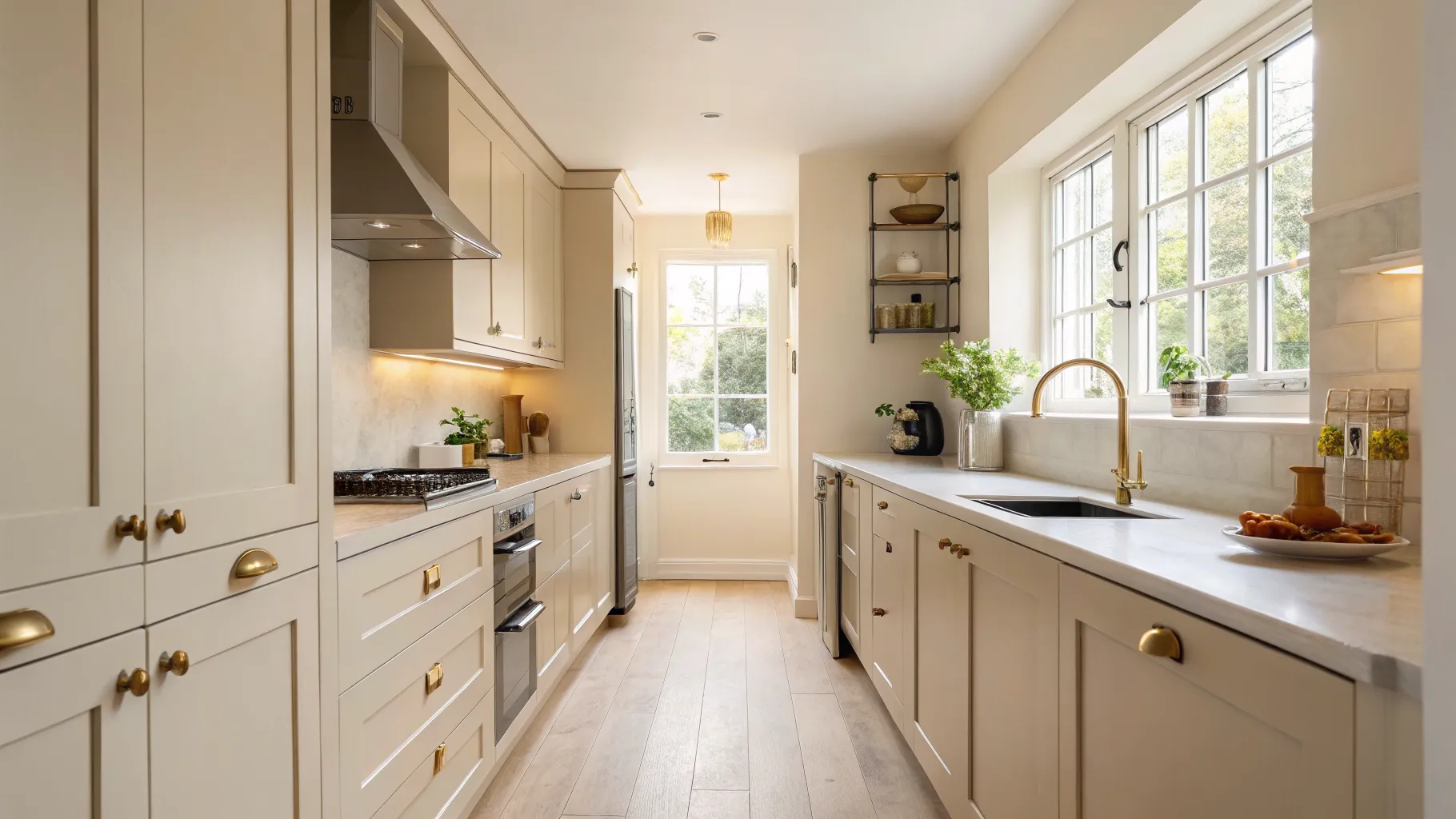
If you are planning a small kitchen, you are working with the normal British kitchen, not a compromised version of a bigger one. The average UK kitchen now sits at around 12.6 square metres, down from roughly 15.7 square metres in the 1970s, and only about 8% of new homes have a kitchen larger than 15 square metres. A “small” kitchen is generally classed as 8 to 12 square metres. So a compact space is the default in terraces, flats and new builds, and the good news is that the design problem is well understood. This guide pairs the usual inspiration with the part most galleries skip: real UK unit dimensions, honest costs, ventilation rules and a layout method that actually fits the room you have.
Start with the standard dimensions
The single biggest advantage in small kitchen design is that British kitchen units are standardised. Howdens, Wren, Magnet, IKEA, Wickes and B&Q all build to roughly the same module, so you can plan to the millimetre before you commit to anything.
| Element | Standard UK dimension |
|---|---|
| Base unit carcass height | 720mm |
| Worktop height from floor | around 900mm with plinth and worktop |
| Base unit depth | carcass 560 to 570mm, around 600mm with the door |
| Worktop depth | 600 to 650mm |
| Base unit widths | 300, 400, 500, 600, 800, 1000mm |
| Wall units above worktop | mounted 450 to 500mm clear of the worktop |
The 300mm and 400mm widths are where small kitchens are won or lost. A 300mm pull-out larder beside the hob holds oils, jars and utensils in the space a chopping board would otherwise waste. A 400mm pull-out next to the sink swallows bin and recycling. Knowing the modules means you can fill awkward gaps with a working unit rather than a filler panel.
The best layout for a compact space
The honest answer to “galley, L-shaped or single-wall” is that the room usually decides for you. Each works well at small scale if you respect what it is good at.
- Single-wall (a kitchen along one wall): the right choice for the narrowest spaces and studio flats. Everything is in reach, but worktop is tight, so you have to plan landing space carefully.
- Galley (two facing runs): the most efficient layout for a small kitchen and very common in London terraces and conversions. Two short runs give you far more worktop and storage than a single wall in the same floor area. Aim for at least 1200mm of clear floor between the runs so two people can pass and appliance doors can open.
- L-shaped (two adjoining walls): good where the room is squarish rather than long. It frees a corner for a small table or a couple of stools and keeps the cook out of the through-route.
This is what most small kitchen design guides get wrong: they show you photographs and tell you to add shelves. The layout is the decision that actually changes how the room works, and it costs nothing to get right on paper. If you want help judging what a designer adds at this stage, see our guide to hiring an interior designer in London.
Does the work triangle still apply?
Yes, but compressed. The classic kitchen work triangle links sink, hob and fridge, with each leg ideally 1.2 to 2.7 metres and the three legs adding up to between roughly 4 and 8 metres (you will see this written in feet, 4 to 9ft per leg, on American sites). Maytag has a clear explainer of the kitchen work triangle if you want the full version.
In a small kitchen the triangle shrinks, and in a single-wall layout it collapses into a line. The rule that still matters is the one behind the triangle: do not sandwich the hob or the sink with no worktop either side. You need landing space to set a pan down beside the hob and a wet dish down beside the sink. A common mistake is ending up chopping on one side of the room and walking across to cook on the other. Keep prep, hob and sink in a sensible run and the small kitchen works harder than a badly planned large one.
Storage: the highest-leverage moves
In a mini kitchen you cannot add floor area, so you add height and efficiency instead.
- Go floor to ceiling. Tall cabinetry to the ceiling is the single best move in any small kitchen. The top shelves take the things you reach for twice a year, and the wall stops being dead space above standard units.
- Choose drawers over cupboards for pans. Deep pan drawers beat base cupboards for usable storage, because you pull the contents out to you rather than kneeling and reaching into a dark box. This is the most repeated piece of advice from people who have lived with both.
- Use pull-outs in the narrow gaps. A 150mm or 300mm pull-out larder is purpose-built for the slivers a small kitchen leaves over.
- Hide the function, not the space. A current trend worth borrowing is the small-scale “appliance garage”: a pocket-door cupboard that hides the kettle, toaster and a coffee station so the worktop reads as clear. It does not create space, but a tidy worktop makes a small room feel larger.
Slimline appliances that fit
You do not have to give up appliances in a small kitchen. The narrow versions are made for exactly this.
| Appliance | Compact size | Notes |
|---|---|---|
| Dishwasher | 45cm wide (standard is 60cm) | Slimline models from Bosch, Beko, AEG, Hotpoint and Indesit; depth around 55 to 60cm with the door |
| Fridge freezer | around 45 to 55cm wide | Beko markets a narrow fridge freezer range aimed at galley kitchens and flats |
| Oven and hob | combined or a 60cm pairing | A single oven plus a 4-zone induction hob suits most compact kitchens better than a range cooker |
Check the live spec sheet for capacity and exact depth before you order, because models change and the door and handle add to the carcass depth. We have not verified any single model’s place settings or litres here, so treat the brands as categories and confirm the numbers on the retailer’s current page.
Ventilation: the rule people miss
Extraction is a building regulations matter, not just a comfort one, and it is easy to overlook in a small kitchen where ducting outside may be awkward. Under the official guidance, an extractor sited over the hob and venting to outside across the full width of the hob must achieve at least 30 litres per second. A hood that is not directly over the hob, or one that recirculates rather than ducts outside, must manage at least 60 litres per second. The detail is in the GOV.UK Approved Document F on ventilation.
Recirculating hoods, which filter the air and return it to the room rather than ducting it out, are common in flats and internal kitchens where there is no external wall to vent through. They are a legitimate choice, but they need the higher airflow figure and regular filter changes to keep up. If you are unsure whether your works need sign-off, the Planning Portal covers when kitchen works need building control.
What a small kitchen actually costs
Here is the part the photo galleries leave out. Cost depends far more on the materials and how much the layout changes than on the floor area, and the spread is wide: entry-level schemes built on Wickes or IKEA carcasses sit at the bottom, while premium Howdens, Magnet or bespoke work climbs to several times that. By layout, a galley tends to land at the lower end and an L-shaped kitchen a little higher, because it carries more units and a corner solution. Fitting labour is a meaningful slice on its own, charged by the day. For current figures, the cost guides at BestBuilders and Checkatrade set out the ranges in detail.
Now the counterintuitive bit: a small kitchen costs more per square metre, not less. The fixed costs (plumbing, electrics, building control and fitting labour) do not scale down with the room. They spread across fewer units, so the cost per square metre rises even as the total falls. Do not assume a compact kitchen is a cheap one. Keep a 10 to 15% contingency, especially in older London housing where you cannot see what is behind the plaster. For the design fee specifically, our kitchen interior design cost in London page separates the planning fee from the build, and the interior design budget planner shows how to split the total.
Making a small kitchen feel bigger
Tricks that work, with the dated advice corrected:
- Light and bright still helps, but it does not have to be white. The 2026 shift is away from cool white and grey toward warm creams, clay tones and earthy sage or olive greens. Painting the cabinets and walls in one tone, sometimes called colour-drenching, removes the visual breaks that chop a small room into pieces and makes it feel calmer and larger.
- Reflect light. A glossy or satin worktop, a mirrored or glass splashback, and undercabinet lighting all bounce daylight around a compact room.
- Reduce visual clutter. Handleless or slim-handled doors, a single worktop material and the appliance garage above all keep the eye moving rather than catching.
- Keep the floor visible. Wall-hung or plinth-recessed units and a continuous floor that runs under everything make the footprint read as bigger than it is.
Can you fit an island or a table?
Usually not a fixed island, and that is fine. The 2026 answer is the micro or mobile island: a portable kitchen cart, a baker’s table or a slim harvest table on castors that you pull out for prep and tuck away after. It gives you the extra worktop and the sociable surface without permanently blocking the floor. A 600mm-deep peninsula or a fold-down breakfast bar is the other route where the wall allows it.
In London conversions, a related idea is broken-plan rather than open-plan: zoning the cooking area with a half-wall, an archway or a glass partition instead of one large open room. It keeps cooking smells and clutter contained while still feeling connected, which suits the proportions of a terrace or a flat conversion better than knocking everything through.
The London angle
London kitchens carry constraints the national guides ignore. Victorian and Edwardian terrace galleys are long and narrow by design. Flat conversions often have no external wall to duct an extractor through, which is why recirculating hoods come up so often. Side-return extensions are the classic London move to widen a galley, but they bring planning, party wall agreements and building control into the picture. Leaseholders and listed-building owners face extra consents before anything starts. None of these change the design principles above; they change the order of operations, so settle the consents and the ventilation route before you fall in love with a layout.
Frequently asked questions
How do I make a small kitchen look and feel bigger? Go floor to ceiling with cabinetry, keep the worktop clear, use reflective surfaces and undercabinet lighting, and choose a single warm tone across walls and units to remove visual breaks. Wall-hung units and a continuous floor that runs under everything make the footprint read as larger.
What is the best layout for a small kitchen? The room usually decides. A galley (two facing runs) is the most efficient for a long, narrow space and gives the most worktop and storage; single-wall suits the very narrowest rooms and studios; L-shaped works where the space is squarer and frees a corner for a small table. Leave at least 1200mm of clear floor in a galley.
How much does a small kitchen cost to fit in the UK? It varies widely with materials and how much the layout changes, far more than with floor area. A galley tends to sit at the lower end and an L-shaped kitchen a little higher, with fitting labour a separate charge on top. Note that small kitchens cost more per square metre because fixed costs like plumbing and labour do not scale down with the room. See the BestBuilders and Checkatrade cost guides linked above for current figures.
Can I fit a slimline dishwasher in a small kitchen? Yes. Slimline dishwashers are 45cm wide rather than the standard 60cm, and brands including Bosch, Beko, AEG, Hotpoint and Indesit stock them. Check the depth with the door (around 55 to 60cm) and the place-setting capacity on the live product page before ordering.
Does the work triangle still matter in a tiny kitchen? The principle does, even though the triangle compresses or collapses into a line in a single-wall layout. The rule that survives is to keep landing space either side of the hob and sink, so you are not chopping on one side and cooking on the other.
What colour makes a small kitchen feel bigger, and does it have to be white? No. The old “always go white” advice has dated. For 2026, warm creams, clay tones and earthy greens work well, and painting cabinets and walls in a single tone makes the room feel larger by removing the visual joins. Light still helps, but the tone can be warm rather than stark white.
For the full picture on what the design work itself costs in the capital, see our guide to kitchen interior design cost in London.
The Folio
Want more like this in your inbox?
One considered idea for your London home, every Thursday.
SubscribeMore from KDS London
All guides
How Much Does an Interior Designer Cost in London in 2026?
What interior designers charge in London in 2026: hourly rates, day rates, per-room fees and percentage models, with real figures and what each one buys you.
Read
Navy Kitchen Ideas: Blue, Teal and Cobalt Cabinet Designs
Navy kitchen ideas that work: the best blue cabinet shades, worktop and hardware pairings, and how to use navy, teal and cobalt without dating the room.
Read
Gold and Brass Bathroom Accessories: How to Style Warm Metallics
How to choose and style gold bathroom accessories and brass fittings, from brushed vs polished finishes to mixing metals and avoiding tarnish.
Read