How to Choose an Interior Designer: 7 Checks Before You Pay
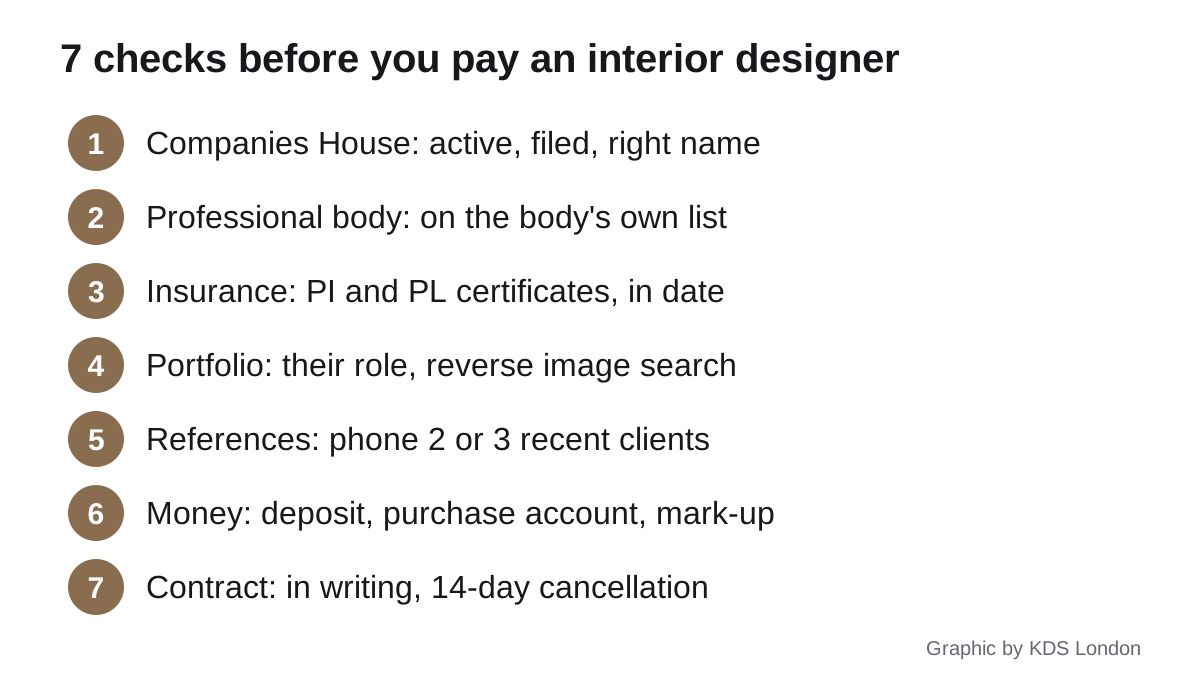
How to choose an interior designer usually gets answered with “look at their portfolio and see if you click”. Both matter, but neither tells you whether the business will still be trading when your sofa is due, whether the photographs are really their work, or what happens if a contractor floods the flat below. Interior design is not a protected title in the UK, so anyone can call themselves a designer with no training, no insurance and no complaints route.
This page is the due diligence: seven checks you can run yourself, mostly free and online, before you sign or pay a deposit. Run them on your final two or three names, after the first meetings. For what to ask in those meetings, see our 10 questions to ask an interior designer; for where to find names in the first place, start with how to hire an interior designer in London.
1. Check the business on Companies House
If the designer trades as a limited company, look it up on Companies House. It takes two minutes and is free.
- Is the company active? A status of “active - proposal to strike off” means it is behind on its filings and may be closed.
- How old is it? A new company is not a problem in itself, but if the designer told you they have run their studio for 15 years, the company should not have been set up last spring.
- Are the accounts and confirmation statement up to date? Overdue filings are an early sign of a business under strain.
- Who are the directors, and what else have they run? Click through each director’s other appointments. A string of companies that were dissolved after a year or two, or went into liquidation, is worth asking about.
- Does the registered name match the contract? The company named on your contract and invoices is the one you have a claim against. It should be the one you checked.
You can also search the Companies House register of disqualified directors, and GOV.UK’s bankruptcy and insolvency register for sole traders. Neither should turn up your designer.
A sole trader will not appear on Companies House. That is normal for small studios, but it means you are dealing with an individual, so the insurance and reference checks below matter even more.
2. Verify any professional body membership
The British Institute of Interior Design (BIID) has two levels that are often blurred in marketing. BIID Registered Interior Designer® is the professional status: it requires six years of combined education and experience, a professional review, insurance and ongoing training. Plain membership is broader. The BIID lists registered designers on its Find an Interior Designer page and keeps a separate full list of members.
Look the person up by name. If they use the BIID logo on their website and cannot be found on either list, ask why. Membership lapses, and some people keep the badge up. The same applies to any other body a designer names, such as the Society of British and International Interior Design: check the body’s own directory, not the designer’s website.
3. Ask to see the insurance certificates, then read them
Every designer should be able to send you two certificates within a day:
- Professional indemnity (PI) covers you if their design advice is wrong and costs you money: a kitchen layout that does not fit, a specified floor that fails, an instruction that breaches building regulations.
- Public liability (PL) covers injury to people and damage to property caused by the designer or their staff, such as a fitter they sent damaging your neighbour’s ceiling.
When the certificates arrive, check three things: the name on the policy matches the business on your contract, the policy dates cover the length of your project, and the limit of cover is sensible for the value of the work. If the designer will manage builders on site, ask whether those contractors carry their own public liability too, and get copies. A designer who answers “I’m covered” but never sends the certificate has told you something.
4. Test the portfolio
A beautiful portfolio is where most people stop. Instead, treat it as a set of claims to check.
- Ask which projects were theirs alone. Plenty of designers include work they did as a junior at a bigger studio, or projects where an architect did the layout and they chose the cushions. Both are fine if they say so. Ask “what exactly was your role on this one?”
- Reverse image search two or three photos. Use Google Lens or a similar tool. If the same image appears on another studio’s site, a hotel’s website or a stock library, that is a serious problem.
- Look for photographer credits and addresses. Real projects are often credited to a named photographer, and a designer can usually tell you the street or area. Vague answers about “a client in Chelsea” for every project are a warning.
- Ask for something unfinished. A designer with steady work will have a project on site now. Seeing one in progress, with the mess and the snagging, shows you how they really run a job.
5. Take up references properly
Ask for two or three past clients whose projects were similar in size to yours, ideally finished in the last two years. Then phone them; an email reference tells you very little. Useful questions:
- Did the project finish within the budget you agreed at the start, and if not, why?
- How close to the original timetable did it end?
- What went wrong, and how did the designer handle it?
- Did you ever feel surprised by an invoice?
- Would you hire them again for your next home?
Listen for hesitation more than words. Most clients will say something nice; the useful signal is whether they volunteer specifics. If you can, visit a finished project in person. It is the only way to see the quality of joinery and finishes that photographs flatter.
Online reviews on Google, Houzz and Trustpilot help as a background check. Read the critical ones for patterns, such as several clients mentioning late deliveries or unexplained mark-ups, and see how the designer replied.
6. Read how the money works before you pay any of it
Most disputes with designers are about money, so the paperwork should make it plain:
- Deposit size. A design fee in stages is normal. A large upfront payment for the whole project, or for furniture months before it is ordered, is not.
- Purchase money. Ask whether money you pay for furniture and materials goes straight to suppliers, into a separate client account, or into the designer’s own business account. If it is their own account and the business fails, that money is at risk.
- Mark-ups and trade discounts. The contract should say whether the designer adds a percentage to purchases or passes on their trade discount. Our interior designer fees page explains each model.
- How you pay. Paying by credit card for a single item or payment between £100 and £30,000 gives you a claim against the card provider under Section 75 of the Consumer Credit Act if the business fails to deliver. Bank transfer does not. Avoid cash.
7. Get a written contract and check your cancellation rights
Insist on a written agreement before any work starts. It should set out the scope, the stages, the fees and how they are calculated, who is responsible for contractors, how changes are agreed, and how either side can end the contract. The BIID publishes a client’s guide and standard contract forms that designers can use; a designer using a recognised form is a good sign. Our interior design contract guide covers each clause.
If you agree the contract at home or online rather than at the designer’s premises, the Consumer Contracts Regulations normally give you 14 days to cancel. If you ask the designer to start within those 14 days, you may have to pay for the work done so far. Under the Consumer Rights Act 2015, any service you buy must also be carried out with reasonable care and skill. Citizens Advice explains how to use both if things go wrong.
Red flags that should end the conversation
- They will not put the fee structure, or the mark-up, in writing.
- They want the whole fee, or most of the furniture money, upfront.
- No certificate for professional indemnity or public liability insurance.
- No references from recent clients, or only friends and family.
- Pressure to sign quickly to “hold a slot” or catch a supplier’s price.
- The company on the contract is not the one you checked, or does not exist.
One of these on its own may have an innocent explanation. Two or more, and keep looking.
Frequently asked questions
How do I know if an interior designer is legitimate? Check the business on Companies House, confirm any professional body membership on that body’s own directory, and ask for their professional indemnity and public liability insurance certificates. A legitimate designer will expect these checks and will not mind them.
Does an interior designer need to be qualified in the UK? No. “Interior designer” is not a protected title, so there is no legal minimum qualification. BIID Registered Interior Designer® status is the closest thing to a recognised professional standard.
What insurance should an interior designer have? Professional indemnity insurance, which covers losses caused by their advice or designs, and public liability insurance, which covers injury and property damage. If they employ staff they also need employer’s liability insurance.
How many interior designers should I interview? Two or three is enough for most projects. Meet each one, then run the checks on this page on the one or two you prefer before you sign anything.
Should I pay an interior designer a deposit? A deposit or first-stage fee is normal. It should be a modest share of the design fee, set out in the contract, not the whole fee or large sums for furniture before anything has been ordered.
Can I cancel a contract with an interior designer? If you signed at home or online, you normally have 14 days to cancel under the Consumer Contracts Regulations, though you may pay for work already done if you asked them to start early. After that, it depends on the termination clause in your contract.
The Folio
Want more like this in your inbox?
One considered idea for your London home, every Thursday.
SubscribeMore from KDS London
All guides
How Much Does an Interior Designer Cost in London in 2026?
What interior designers charge in London in 2026: hourly rates, day rates, per-room fees and percentage models, with real figures and what each one buys you.
Read
Navy Kitchen Ideas: Blue, Teal and Cobalt Cabinet Designs
Navy kitchen ideas that work: the best blue cabinet shades, worktop and hardware pairings, and how to use navy, teal and cobalt without dating the room.
Read
Gold and Brass Bathroom Accessories: How to Style Warm Metallics
How to choose and style gold bathroom accessories and brass fittings, from brushed vs polished finishes to mixing metals and avoiding tarnish.
Read