10 Questions to Ask an Interior Designer Before You Sign
The questions to ask an interior designer before you hire them are the ones that expose how the money works and who carries the risk. Portfolios show taste. They do not show whether the designer marks up the sofa, who answers the phone when the plasterer goes missing, or what happens if you hate the first concept. Those are the things that sour a London project, and every one of them can be settled in a single conversation before you sign.
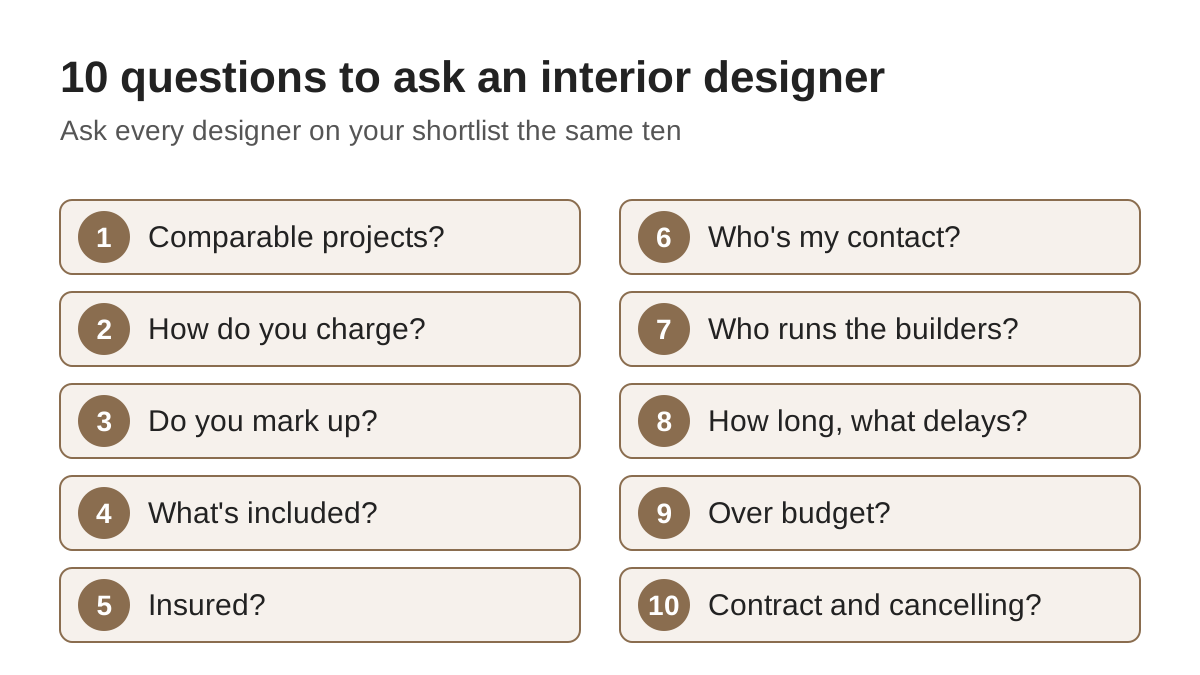
Below are ten questions, why each matters, and what a good answer sounds like next to an answer that should make you pause. Ask the same ten of every designer you shortlist and the comparison gets much easier.
1. “Have you done a project like mine, and can I speak to that client?”
Why it matters: a designer who has done three Victorian terraces in Islington knows where the chimney breasts, party walls and narrow hallways cause trouble. A designer whose work is all new-build penthouses may not.
Good answer: two or three comparable projects, with an offer to put you in touch with a past client or show you round a finished home.
Pause if: every example is a different kind of property from yours, or references are “confidential” across the board.
2. “How exactly do you charge?”
Why it matters: designers charge in different ways (a fixed fee, an hourly rate, a percentage of the project cost, or a mix) and the same scheme can cost very different amounts depending on the structure. Our page on interior designer fees explained sets out each model.
Good answer: a clear method, given in writing, with what each stage includes and when invoices fall due.
Pause if: the fee is “it depends” with no structure, or a percentage fee is quoted without saying what it is a percentage of.
3. “Do you mark up furniture and materials, and do I see the trade price?”
Why it matters: many designers buy at a trade discount. Some pass all of it to you, some keep part of it, and some add a mark-up on top. None of these is wrong if it is disclosed. Our page on interior designer trade discounts explains how it works.
Good answer: a straight statement of the policy, written into the contract, such as “we pass on our trade discount and charge a procurement fee of X%.”
Pause if: the answer is vague, or you are told you cannot see supplier invoices.
4. “What is included, and what counts as an extra?”
Why it matters: the number of design revisions, site visits, drawings and shopping trips included in the fee is where most later disputes start.
Good answer: a written scope listing the stages, the number of revision rounds and how extra work is charged.
Pause if: “unlimited changes” with no definition, or no scope at all.
5. “Are you insured, and can I see the certificates?”
Why it matters: professional indemnity insurance covers you if bad advice costs money to put right; public liability covers damage or injury on site. To be listed as a BIID Registered Interior Designer, the British Institute of Interior Design requires both to be held, along with six years of education and work experience, a professional review and annual CPD. You can search the BIID’s find an interior designer directory to check a name.
Good answer: “Yes, here are the certificates,” with current dates.
Pause if: reluctance to show them. A designer without cover is not necessarily a cowboy, but you should know before you hand over a large budget.
6. “Who will I actually deal with day to day?”
Why it matters: at a larger studio the person who wins the job is often not the person who runs it.
Good answer: a named project lead, how often you will hear from them, and how they prefer to be contacted.
Pause if: the founder sells the project but cannot say who will deliver it.
7. “Do you manage the builders, or do I?”
Why it matters: some designers produce the scheme and hand it to you or your builder. Others tender the work, appoint trades and run the site. The difference changes your workload, your fees and who is accountable when something goes wrong. If structural work is involved, see our page on designer vs decorator vs architect to work out who you need.
Good answer: a clear line on who contracts with the builder, who signs off work, and who is responsible for checking quality.
Pause if: “we keep an eye on it” without any defined role.
8. “How long will it take, and what usually causes delays?”
Why it matters: lead times on made-to-order furniture, kitchens and lighting are routinely many weeks, and a designer who has done this before will know where your project is likely to slip. Our page on how long interior design takes gives typical timings by stage.
Good answer: a stage-by-stage timeline with the long-lead items called out, and honesty about what is outside their control.
Pause if: a confident completion date with no caveats, especially on a whole-house project.
9. “What happens if I do not like the first concept, or the budget runs over?”
Why it matters: this tells you how the designer handles disagreement. Budgets slip on almost every renovation, and how a designer reports and controls that matters more than the original figure. Our interior design budget planner helps you set a realistic number to start from.
Good answer: a set number of revisions within the fee, and a process for flagging cost changes to you before they are committed.
Pause if: the designer bristles at the question.
10. “Can I see your contract, and how do I cancel?”
Why it matters: the contract is where all the answers above should be written down. If you sign a contract for services in your own home rather than at the designer’s studio, the Consumer Contracts Regulations normally give you 14 days to cancel. If you ask the designer to start within that period, you may have to pay for work already done. The full text is in the Consumer Contracts (Information, Cancellation and Additional Charges) Regulations 2013.
Good answer: a written contract sent ahead of signing, with fees, scope, payment schedule, termination terms and ownership of drawings. Our interior design contract guide lists the clauses to check.
Pause if: work is to start on a handshake, or you are pressed to sign at the first meeting.
Questions a good designer will ask you
The conversation should run both ways. Expect a good designer to ask about your budget (including furniture, not just building work), how you use each room, who lives in the house, what you like and dislike, and your timescale. A designer who asks you nothing is unlikely to design for you. Turning up with a written brief speeds this up: see how to write an interior design brief, and our page on the first interior design consultation for how the meeting usually runs.
A simple way to compare answers
Write the ten questions down the side of a page and a column for each designer. After each meeting, mark each answer clear, vague or missing. The designer with the best portfolio is not always the one with the most clear answers, and it is the clear answers that predict how the project will feel to live through. For the wider shortlisting process, see our page on how to hire an interior designer in London.
Frequently asked questions
What questions should I ask an interior designer before hiring? Ask about comparable past projects and references, how they charge, whether they mark up products, what the fee includes, their insurance, who runs your project day to day, whether they manage the builders, the timeline, how they handle budget overruns, and to see the contract before you sign.
Should I ask an interior designer about their budget for my project? Yes, and the designer should ask about yours. Give a realistic total that includes furniture and finishes, and ask how they will report spending against it as the project goes.
Is it rude to ask an interior designer about mark-ups? No. Trade discounts and mark-ups are a normal part of how many designers earn, and a professional will explain their policy without fuss. The problem is a policy you only discover afterwards.
How do I check an interior designer is qualified? There is no legal requirement for a licence to call yourself an interior designer in the UK. Checking for BIID registration, current insurance certificates and recent references is the practical test.
How many interior designers should I interview? Two or three is enough for most projects. Ask each the same questions so you can compare like with like.
Can I cancel a contract with an interior designer? If you signed the contract in your home rather than at their premises, you normally have 14 days to cancel under the Consumer Contracts Regulations, though you may pay for work you asked them to start in that period. After that, it depends on the termination terms in the contract.
The Folio
Want more like this in your inbox?
One considered idea for your London home, every Thursday.
SubscribeMore from KDS London
All guides
How Much Does an Interior Designer Cost in London in 2026?
What interior designers charge in London in 2026: hourly rates, day rates, per-room fees and percentage models, with real figures and what each one buys you.
Read
Navy Kitchen Ideas: Blue, Teal and Cobalt Cabinet Designs
Navy kitchen ideas that work: the best blue cabinet shades, worktop and hardware pairings, and how to use navy, teal and cobalt without dating the room.
Read
Gold and Brass Bathroom Accessories: How to Style Warm Metallics
How to choose and style gold bathroom accessories and brass fittings, from brushed vs polished finishes to mixing metals and avoiding tarnish.
Read