Interior Designers London: What Changes in Each Borough
Interior designers in London work under different constraints depending on the postcode. Westminster says more than 76% of the city is in a conservation area and Camden says about half of its borough is, while a Canary Wharf flat raises questions about the building’s management, not its heritage. So the most useful thing to ask a shortlisted designer is not whether they cover your area. It is what they have done in a building like yours.
KDS London is an independent guide, not a design studio, so this page does not list areas we work in. It sets out what tends to shape a project in each part of London, and how to find a designer who has handled it. For the wider process, see how to find and hire an interior designer in London.
Why the borough matters less inside than out
Purely internal work is generally not “development” under planning law, as our planning permission page explains. A conservation area alone does not stop you replanning a kitchen. It starts to matter when the job reaches the outside: windows, a flue, an extractor vent on the front elevation, or a rear extension. An Article 4 direction can remove further rights, so check with the borough before anyone draws anything external.
Listing is different. If the building is listed, the protection covers the interior as well, and you need listed building consent for work that affects its character. Conservation area status and listing are separate questions, and a designer should check both in the first meeting.
London areas compared
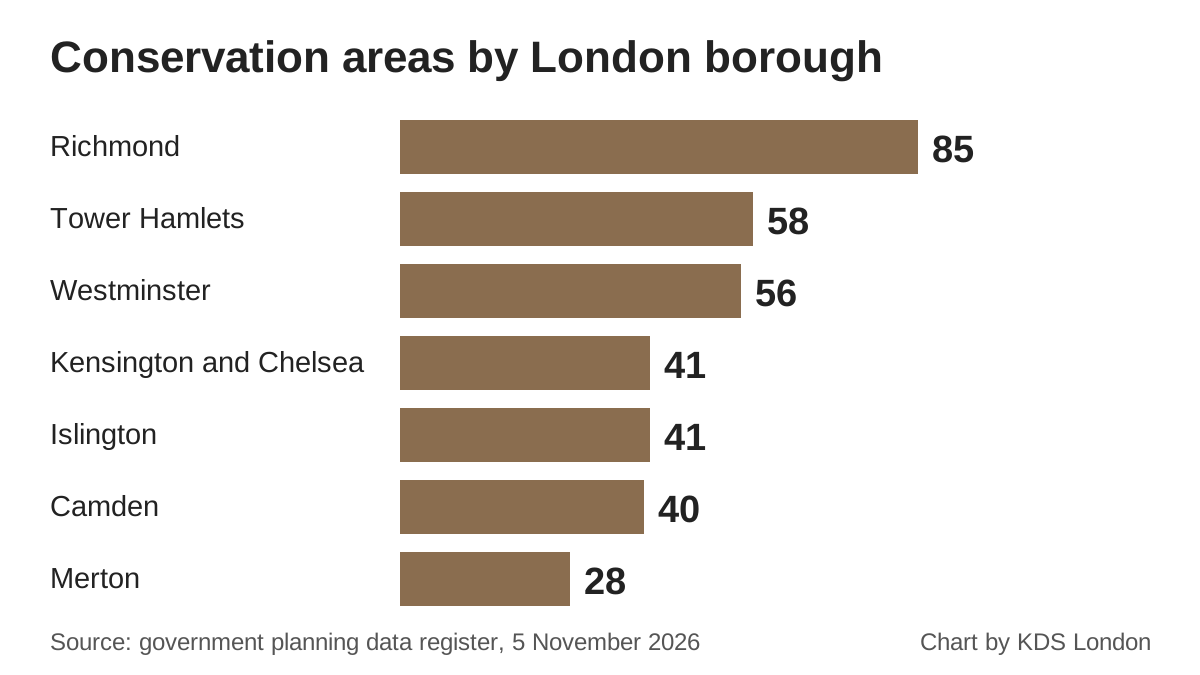
The counts come from the government’s planning data register, read on 5 November 2026. Where a council publishes its own figure for Westminster, Camden or Richmond, it matches. The notes on building types are general: your own street may differ.
| Area | Borough | Conservation areas | What to raise with a designer |
|---|---|---|---|
| Chelsea, Kensington, Notting Hill, Holland Park | Kensington and Chelsea | 41 | Listed terraces and mews, Article 4 directions, converted flats with a freeholder’s licence |
| Knightsbridge | Kensington and Chelsea, and Westminster | 41 and 56 | Which council you are dealing with, and mansion block rules |
| Mayfair, Marylebone, Pimlico | Westminster | 56 (over 76% of the city) | Listing, estate and freeholder consents, working hours in the lease |
| Hampstead, Belsize Park | Camden | 40 (about half the borough) | Large houses split into flats, shared walls and floors |
| Islington, Canonbury | Islington | 41 | Georgian and Victorian terraces, side returns, party walls |
| Richmond, Twickenham, Barnes | Richmond upon Thames | 85 | Family houses, extensions and garden rooms, external work rules |
| Wimbledon | Merton | 28 | Larger suburban houses, kitchen extensions, party walls |
| Canary Wharf, Wapping | Tower Hamlets | 58 | Tower rules, building management sign-off, delivery and lift bookings |
A high count does not mean a stricter borough. Richmond has the most on this list with 85, but a count says nothing about how much land they cover: Westminster’s 56 cover over 76% of the city. Treat the number only as a reason to check your own address.
What to ask, by type of home
A listed or period house. Ask to see a project where they obtained listed building consent, and who wrote the heritage statement. Removing a fireplace or changing a door can need consent, and carrying out unauthorised work is a criminal offence.
A flat in a converted house or mansion block. Ask whether they have worked to a licence to alter, and how they handle noise and flooring rules. Your lease may need freeholder consent for alterations and set the hours for noisy work, so send it to the designer before fees are agreed.
A terrace with a shared wall. Cutting into a party wall usually means serving notice under the Party Wall etc Act 1996. Ask who serves the notice and whether a surveyor’s fee sits in your budget.
A flat in a tower. Ask about the building manager’s requirements, lift booking and fire-stopping. In a tall block, some work needs sign-off from the Building Safety Regulator before it starts.
A family house with an extension. Check whether the designer or an architect leads the planning application, and who coordinates the builder. Our interior design process page sets out who does what at each stage.
How to find a designer in your area
Start with the BIID’s directory, the British Institute of Interior Design’s list of members. You can search by practice name or by distance from your postcode, and its referral form lets you describe a specific project. Then widen the search with projects you admire in magazines or from friends and neighbours who have had similar work done.
A designer does not have to be based near you. Plenty of London studios work across the city, so a relevant project in another borough tells you more than a nearby office. Pages titled “interior designers in [your area]” are usually a studio’s marketing, and the studio may have no office or finished project there. Ask for the address of a completed job nearby, and a past client you can call.
Our seven checks before you pay cover qualifications, contracts and references, and our London cost page sets out what to budget before you make contact.
Frequently asked questions
How do I find a good interior designer in London? Search the BIID directory by postcode, shortlist three, and ask each for a finished project in a building like yours and a past client you can call. Compare written proposals on scope and stages, not just the fee.
Does a London interior designer need to be based in my area? No. Experience with your type of building matters more than the distance to the studio. Ask for an example project, and check whether travel time is charged.
Do I need planning permission for interior design in a conservation area? Purely internal work generally does not need planning permission, even in a conservation area. External work such as windows, flues and vents may, and a listed building needs consent for interior work that affects its character.
How many conservation areas are there in Westminster? Westminster City Council says there are 56, and its character overview says they cover over 76% of the city.
Can my freeholder stop my interior design project? If your lease requires consent for alterations, you will need your freeholder’s licence before the work starts. Send your designer the lease early, as it can affect flooring, layout and working hours.
Are all interior designers in London BIID registered? No. “Interior designer” is not a protected title. BIID Registered Interior Designer® is a professional status you can check on the BIID’s own list.
The Folio
Want more like this in your inbox?
One considered idea for your London home, every Thursday.
SubscribeMore from KDS London
All guides
How Much Does an Interior Designer Cost in London in 2026?
What interior designers charge in London in 2026: hourly rates, day rates, per-room fees and percentage models, with real figures and what each one buys you.
Read
Navy Kitchen Ideas: Blue, Teal and Cobalt Cabinet Designs
Navy kitchen ideas that work: the best blue cabinet shades, worktop and hardware pairings, and how to use navy, teal and cobalt without dating the room.
Read
Gold and Brass Bathroom Accessories: How to Style Warm Metallics
How to choose and style gold bathroom accessories and brass fittings, from brushed vs polished finishes to mixing metals and avoiding tarnish.
Read