Traditional Kitchen Design: Classic Styles and How to Achieve Them
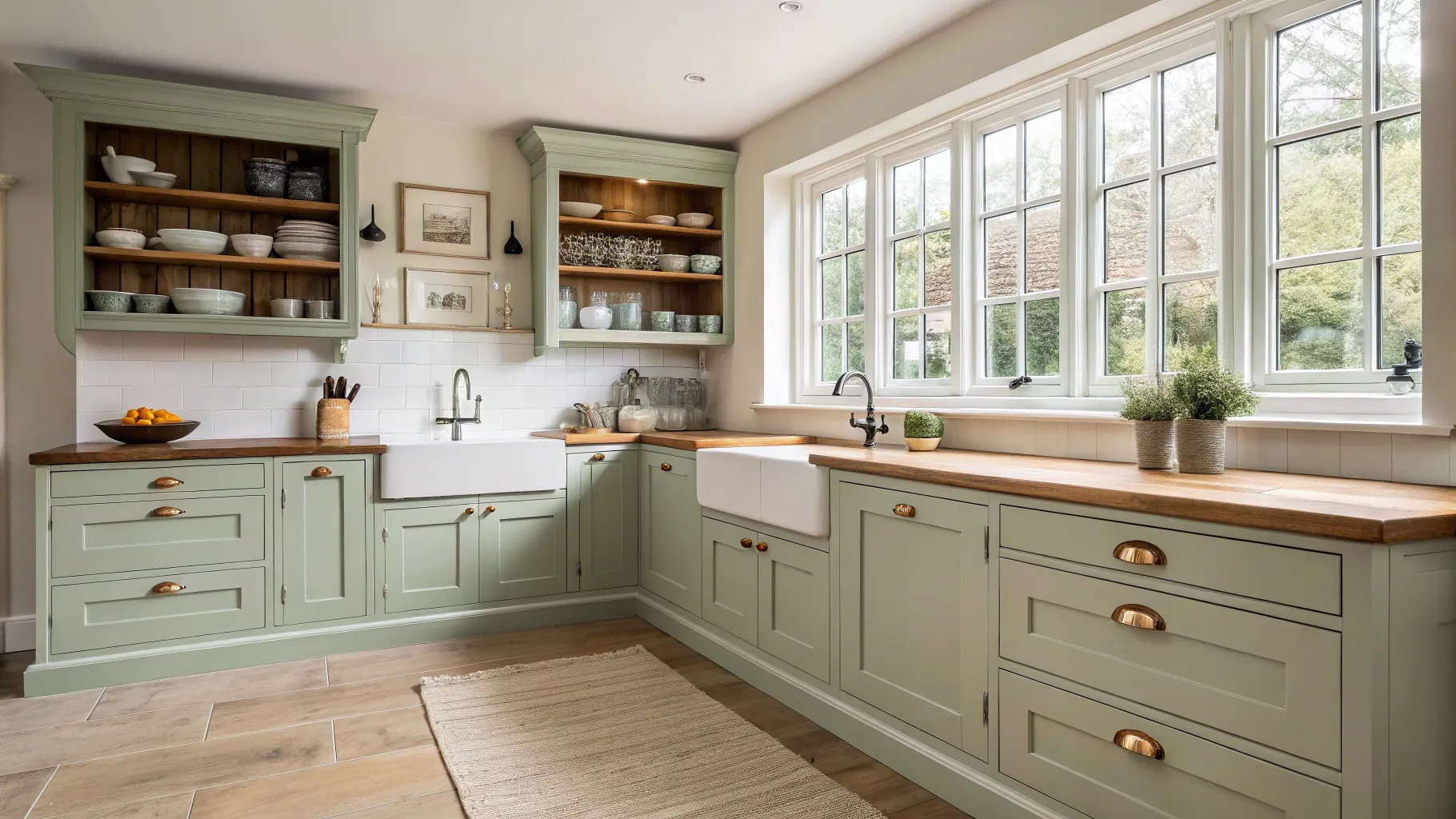
Traditional kitchen design rests on a handful of choices: painted in-frame or Shaker cabinetry, solid hardwood, a fireclay Belfast or butler sink, freestanding furniture like a dresser or island, and a restrained heritage palette of one main neutral plus one accent. Get those right and the room reads as classic whether your house is a Victorian terrace or a new build. The point of this guide is to map the styles clearly, because most pages treat “traditional” and “Shaker” as the same thing, and they are not. Below you will find where they differ, what each choice broadly costs, how long the work takes, and how to make a traditional kitchen sit properly in a London period home.
Traditional is a spectrum, not one look
It helps to think of three points along a line.
Shaker sits at the simple end: a solid, symmetrical, square-framed door with a flat recessed panel and almost no ornament. It is the most popular starting point for a reason; the proportions are quiet and they age well.
Classic English keeps the painted, in-frame feel but adds detail: moulded cornices and pelmets, a glazed display cabinet, perhaps a plate rack, and warmer hardware in brass.
Victorian and ornate goes furthest, with raised-and-fielded panels, carved mouldings, ceiling-height tall units and decorative gold or brass handles. A true Victorian kitchen leans into that richness rather than paring it back.
What ties all three together is the philosophy: functional beauty without fuss. Painted finishes rather than laminate, real timber such as oak, maple or cherry, and display shelving or glazed doors that show the room is meant to be lived in. If you are weighing classic kitchen ideas, decide first where on this spectrum you want to land, because it drives the cost and the cabinetry decisions that follow.
Where Shaker actually came from
The Shaker style is genuinely old, but a common slip is worth correcting. The Shakers were a Christian sect founded in England around 1747 and organised in the United States in the 1780s, so the design tradition is eighteenth-century, not seventeenth as some retailer pages claim. Their ethos was simplicity, utility and honesty: made to last, decoration unnecessary. About the only sanctioned flourish was an occasional small “Tree of Life” motif. You can read the background at Britannica and see the furniture principles set out by The Metropolitan Museum of Art.
The practical takeaway for a UK homeowner: the flat-panel Shaker door is tied to Georgian-era proportions, which is exactly why it suits British period homes so comfortably. That is also the honest answer to whether Shaker kitchens are dated. A look built on Georgian proportions does not really go out of style; it just gets reinterpreted.
In-frame, lay-on and the cost ladder
The single decision that most affects price is how the doors meet the cabinet. This is where good traditional kitchen designers earn their fee, and where the budget moves the most.
- Lay-on (frameless): the door sits over the front of the carcass. This is the baseline cost and the most common Shaker build.
- Mock in-frame: the door is shaped to look inset without a true face frame. Expect roughly ten per cent more than frameless.
- True in-frame: each door is hand-fitted into a face frame fixed to the carcass, the most authentic traditional construction. Budget around twenty to thirty per cent more than frameless, and some bespoke makers quote close to double.
In-frame costs more because every door is fitted individually, which roughly doubles the build time. The face frame also adds around 35mm to each cabinet, so it eats a little space and suits larger rooms better. For a tighter footprint, read our notes on small kitchen design ideas before committing to in-frame.
On overall budget, a full fitted kitchen in the UK typically runs into five figures, with London and the South East at the higher end; flat-pack and high-street routes can come in lower. A mid-sized Shaker kitchen with quartz worktops and integrated appliances sits around the middle of that band once fitted. High-street ranges such as Howdens and Wren anchor the lower end, while bespoke makers like Tom Howley, Plain English and John Lewis of Hungerford set the benchmark at the top. For a fuller breakdown specific to the capital, see our guide to kitchen interior design cost in London and how that splits out by room.
Belfast vs butler: pick by unit size
A fireclay sink is one of the most recognisable traditional features, and the two names are not interchangeable.
A Belfast sink is deeper and narrower, fits a standard 600mm base unit, and traditionally has a weir overflow. A butler sink is shallower and wider, needs roughly an 800mm unit, and the original design had no overflow at all (it was built for butler’s pantries where water was scarce; modern versions usually add one). Both are fired clay finished with a vitreous glaze, non-porous, and resistant to heat, stains and scratches. A single bowl can weigh roughly 25 to 40kg empty, so the cabinet below has to be built to carry it. Sizes do vary between makers, so always check the manufacturer’s specification before ordering your base unit.
The actionable rule: if you only have a 600mm run to give, you are choosing a Belfast. If you have 800mm and want the wider, shallower bowl, the butler fits. Decide this early, because it changes the base cabinet you order.
Making a traditional kitchen work in a London period home
Period properties rarely have square walls, and that is where traditional construction quietly pays off. In-frame and bespoke cabinetry can be scribed to uneven walls far more cleanly than rigid frameless units, so a wonky Victorian terrace ends up looking deliberate rather than patched. Chimney-breast alcoves are an opportunity, not a problem: a dresser or a run of glazed tall units sits naturally in a recess. Ceiling-height units suit the tall rooms of older houses and add storage without crowding the floor.
For the palette, the convention is one main neutral, a milky white, cream or soft grey, plus one heritage accent. Farrow & Ball shades that work well include Studio Green (reads almost black), Bancha (an olive that pairs with aged brass), and on the blue side Inchyra Blue or the dramatic Stiffkey Blue. Finish with brass, aged-brass or unlacquered hardware, cup pulls and knurled knobs, for warmth. If your scheme runs through to a bathroom, the same painted-timber logic carries over; our wooden bathroom cabinets guide covers it.
If you want a new build to read as traditional, the levers are the same: in-frame or Shaker doors, a fireclay sink, real timber or a convincing painted finish, cornicing, and a freestanding piece such as an island or dresser to break the fitted uniformity.
How long it takes
Most design pages skip this, but the timeline shapes how you plan. From demolition to a finished kitchen is usually about three to four weeks. The hands-on fit is shorter, roughly five to ten working days: about a day to rip out the old kitchen, then two to three days to install cabinets.
The detail that catches people out on traditional kitchens is the worktop. Stone, quartz and ceramic surfaces are templated only after the base units are installed, then fabricated off-site, which leaves a gap of around five to ten days before the final fit. Solid timber worktops run about seven to ten days from template to fit. Materials lead times are typically two to three weeks, and bespoke in-frame or hand-painted cabinetry takes longer still, so order early.
Frequently asked questions
What is the difference between a traditional kitchen and a Shaker kitchen? Shaker is one type of traditional kitchen, the simplest. It uses a plain flat-panel, square-framed door with no ornament. “Traditional” is the wider family that also includes classic English and ornate Victorian styles with raised-and-fielded panels, carved mouldings, cornices and decorative brass hardware. Every Shaker kitchen is traditional, but not every traditional kitchen is Shaker.
Are Shaker kitchens still in style in 2026? Yes. The Shaker door is based on Georgian proportions, and that quiet symmetry is widely treated as timeless rather than trend-led. It is reinterpreted with different colours and hardware, but the core look has stayed in demand for decades.
What is an in-frame kitchen and is it worth the extra cost? In-frame means each door is inset within a face frame fixed to the cabinet, the most authentic traditional construction. It costs roughly twenty to thirty per cent more than frameless because every door is hand-fitted, doubling build time, and the frame adds around 35mm per cabinet. It is worth it for period homes with uneven walls and for buyers who want true heritage detailing; in a small room, mock in-frame or frameless may serve better.
Belfast or butler sink, which is right for my kitchen? Choose by unit size. A Belfast is deeper and narrower and fits a 600mm base unit; a butler is shallower and wider and needs about 800mm. Both are hard-wearing fireclay. If space is tight, the Belfast is usually the answer.
How much does a traditional kitchen cost in the UK? A full fitted kitchen typically runs into five figures, with London and the South East at the upper end. Door construction is the biggest variable: true in-frame adds the most, while high-street and flat-pack ranges sit lower. Get itemised quotes, because cabinetry, worktops and appliances each move the total.
How long does it take to design, fit and complete a traditional kitchen? Plan for roughly three to four weeks from demolition to finish. The hands-on fit is five to ten working days, but stone or quartz worktops are templated only after the units go in, adding a five to ten day gap before the final fit. Bespoke painted cabinetry extends lead times further.
The Folio
Want more like this in your inbox?
One considered idea for your London home, every Thursday.
SubscribeMore from KDS London
All guides
How Much Does an Interior Designer Cost in London in 2026?
What interior designers charge in London in 2026: hourly rates, day rates, per-room fees and percentage models, with real figures and what each one buys you.
Read
Navy Kitchen Ideas: Blue, Teal and Cobalt Cabinet Designs
Navy kitchen ideas that work: the best blue cabinet shades, worktop and hardware pairings, and how to use navy, teal and cobalt without dating the room.
Read
Gold and Brass Bathroom Accessories: How to Style Warm Metallics
How to choose and style gold bathroom accessories and brass fittings, from brushed vs polished finishes to mixing metals and avoiding tarnish.
Read