Black Bathroom Ideas: Get the LRV Gap to 30 Points
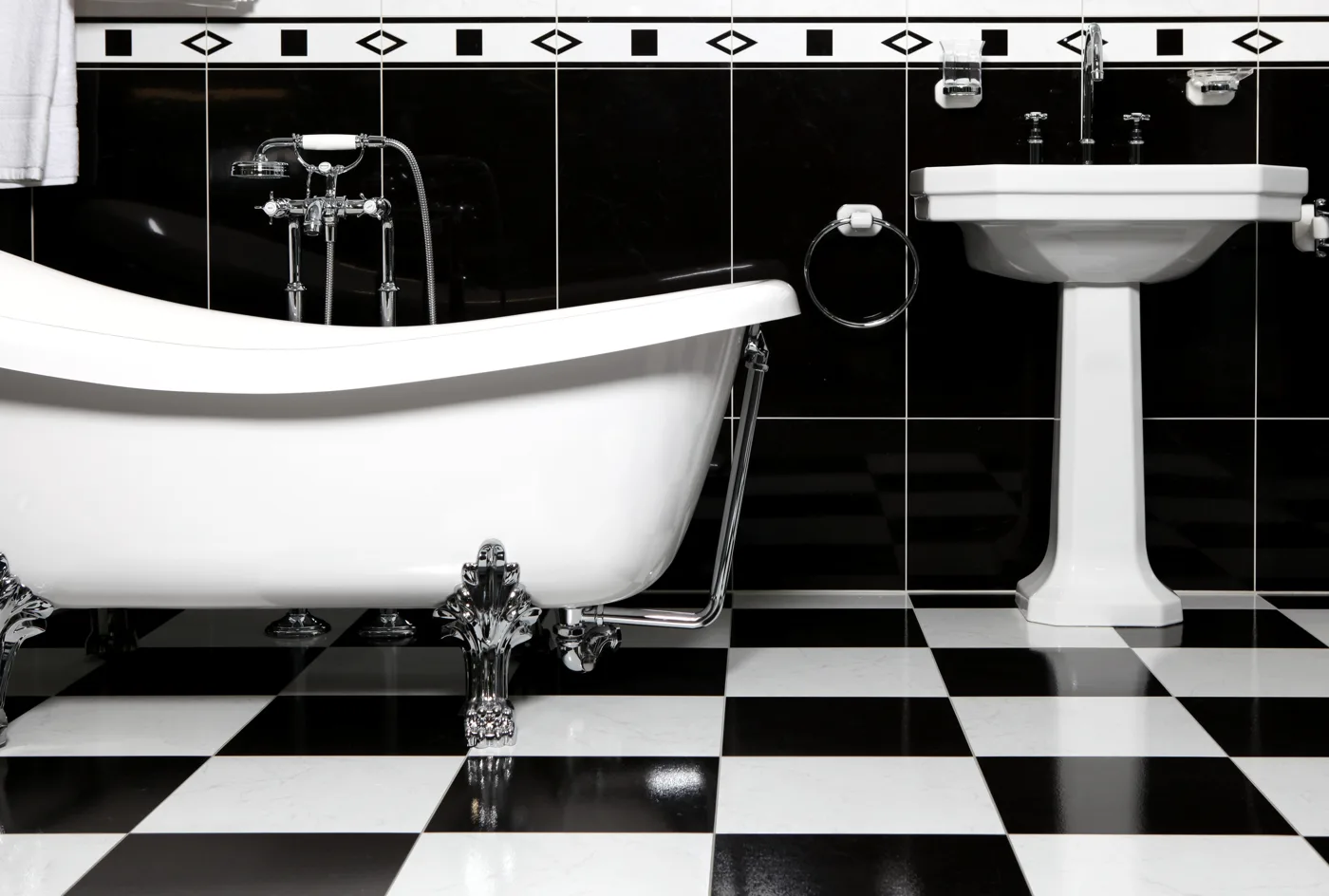
Search black bathroom ideas and you get four hundred photographs and almost no information. The rooms that look expensive and the rooms that look like a bad nightclub are photographed identically, and the thing separating them is not taste. It is a measurable property of every surface in the room, it is published on the datasheet of every tile and every tin of paint, and it has a number attached in the Building Regulations.
This page is about that number, what it means for the pieces of a black bathroom you are actually choosing, and the two practical problems, lighting and London water, that decide whether the room still looks good in three years.
The number: light reflectance value
Every surface has a light reflectance value, or LRV: the proportion of visible light it throws back, on a scale where 0 is a theoretical absolute black and 100 is a perfect white. Brilliant white paint sits around 85. A true matt black is usually somewhere between 4 and 8. Charcoals and off-blacks run from about 8 up to the low twenties.
Manufacturers publish it. Every serious paint brand lists an LRV against each colour, and tile suppliers will give it on request. It costs nothing to ask, and asking is the single most useful thing you can do before committing to a dark bathroom.
The reason it matters is that the Building Regulations define visual contrast in terms of it. Approved Document M Volume 2 sets it out in the definitions:
Contrast visually, when used to indicate the visual perception of one element of the building, or fitting within the building, against another means that the difference in light reflectance value between the two surfaces is greater than 30 points. Where illuminance on surfaces is greater than 200 lux, a difference in light reflectance value should be a minimum of 20 points.
And in the sanitary accommodation section, provision 5.4(k) requires that “the surface finish of sanitary fittings and grab bars contrasts visually with background wall and floor finishes, and there is also visual contrast between wall and floor finishes.”
That document applies to buildings other than dwellings, so nobody is going to refuse your bathroom on it. It is still the right benchmark, for two reasons. It is the number every access consultant, care provider and hotel specifier works to, so it is the standard your room is measured against if it ever needs to work for someone with limited sight. And the physics does not change when you cross your own front door: if a person cannot see where the basin ends and the wall begins in a hotel, they cannot see it in your house either.
The combinations that pass and the ones that fail
Take approximate LRVs, subtract, and look for a gap of 30.
| Combination | Approximate gap | Verdict |
|---|---|---|
| Black tile wall (LRV ~5) with white sanitaryware (~85) | 80 points | Passes comfortably. The classic and the reason it keeps being done. |
| Black tile with a pale stone or light timber floor (~45) | 40 points | Passes. Quietly the best-looking version. |
| Charcoal walls (~15) with white sanitaryware | 70 points | Passes. Reads as almost black in a real room. |
| Black wall with black floor | close to 0 | Fails 5.4(k) outright. Walls and floors must contrast with each other. |
| Black wall with black sanitaryware | close to 0 | Fails. This is the Instagram shot that does not survive contact with a real household. |
| Black wall with a brushed brass basin | depends entirely on the finish | Ask for the LRV. Do not guess from a photograph. |
The two failing rows are exactly the two combinations the galleries push hardest, because they photograph beautifully under studio lighting with a rim light picking out every edge. Your bathroom does not have a rim light.
If you want the all-black look, the honest way to do it is to keep the gap somewhere. A black room with a white basin, a black room with a pale floor, a black room with a bright mirror and a lit niche: all of these keep an edge visible. Black on black on black keeps nothing.
What black does to the light in a room
The second problem is that a bathroom finished in a surface with an LRV of 5 has almost no interreflection. In a white bathroom, most of the light hitting your face has bounced off a wall first, which is why a single ceiling fitting is enough and why the room feels evenly lit. Paint that room black and you delete the bounce. Every lumen now has to arrive directly from a fitting, and anything not in a fitting’s beam goes properly dark.
The consequences are practical rather than aesthetic:
You need more fittings, not brighter ones. A single high-output downlight in a black room gives you a pool of glare and a dark surround. Three or four modest fittings spread across the ceiling, plus something at the mirror, gives you a room you can shave in. Our room lighting calculator will get you to a sensible lumen target for the floor area, and you should aim at the upper end of the range it gives, not the middle.
The mirror light stops being optional. It is the only light in the room hitting your face from the front, and in a dark bathroom nothing is reflecting up off the walls to fill the shadows. Two vertical fittings either side of the mirror beat one bar above it.
The 200 lux clause is your route back. Note what Approved Document M says: above 200 lux on the surface, a 20-point difference is acceptable instead of 30. Good lighting genuinely buys you a darker scheme. This is the technical justification for spending the money on the lighting rather than the tile.
Check the IP rating and the zone. Fittings in and around the bath or shower fall into defined zones with minimum ingress protection ratings under the wiring regulations, and adding more fittings to a dark bathroom means more of them are in a zone. This is an electrician’s question and it is not one to improvise.
The London problem: hard water and matt black
If you are fitting a black bathroom anywhere in the Thames Water region, this is the section that will save you the most annoyance.
Thames Water is unambiguous about the supply: “We source 65% of our water from local rivers and 35% from natural reservoirs underground. This means it passes through soft chalky limestone many times. That’s why all the water in our region is hard.” Its own classification puts hard at 200 to 300 mg/l of calcium carbonate and very hard above 300.
Limescale is white. It dries as a white deposit on whatever it lands on. On a white basin you never notice it for a fortnight. On a matt black basin, a matt black tap and a black shower tray, you notice it the same evening, and every evening after.
This is not a reason to avoid black. It is a reason to make three specific choices:
Prefer PVD over powder coat on brassware. Physical vapour deposition gives a hard, bonded finish that tolerates being wiped daily. A painted or powder-coated matt black tap will wear at the handle and around the spout, and once it wears, limescale sits in the wear. Ask which it is, because both are sold as “matt black”. Our bathroom taps guide covers the finishes in more detail.
Avoid acid descalers on black finishes entirely. Most proprietary limescale removers will dull or strip a coated black finish. The manufacturer’s care sheet will say so and people read it after the damage. A daily wipe with a soft cloth is the maintenance regime; there is no shortcut.
Consider gloss for the horizontal surfaces. Matt black on a wall is fine. Matt black on a shower tray, a basin bowl or a worktop is a daily chore in hard water. A satin or gloss finish in the same colour reads almost identically at a distance and cleans in a tenth of the time.
Thames Water’s own scale advice, incidentally, includes running your hot water at 60 degrees rather than hotter, which is worth knowing for the shower valve as well as the kettle.
Where black earns its keep
Black is at its strongest in the rooms where you are not trying to make anything feel bigger.
The downstairs loo is the best black room in most houses. It has no natural light to lose, you are in it for ninety seconds, and the drama is the point. It is also the cheapest room in the house to be bold in. See downstairs loo design ideas.
A large bathroom with real windows can carry black walls because the daylight does the work the reflectance is not doing. This is where the full dark scheme actually looks like the photographs.
As an accent rather than a scheme. Black grout with white metro tile, black framed shower screens against pale walls, a black vanity under a white basin: all of these read as a black bathroom to a visitor and none of them create a contrast problem. Modern bathroom design ideas has more of this approach, and grey bathroom ideas is the softer version of the same instinct.
Where it struggles is the small internal bathroom with one downlight and no window, which is unfortunately the room most people are searching for these ideas about. If that is your room, read small bathroom design ideas first and treat black as trim rather than as the walls.
What it costs, and where the money goes
A black bathroom is not intrinsically more expensive than a white one, but three lines in the quote reliably move.
Lighting. More circuits, more fittings, correct IP ratings, and probably a separate mirror circuit. This is the line worth spending on and the one people cut.
Tiling labour. Dark tiles show lippage, uneven grout lines and any deviation in the setting out far more than pale ones do, because every shadow is a hard edge against a flat field. The same tiler charging the same day rate will take longer, and should.
Brassware. A genuine PVD black finish costs more than a chrome equivalent from the same range. It is the difference between a tap that looks the same in five years and one that does not.
For where those sit in a wider budget, interior design cost per room and the tile calculator are the practical starting points, and what an interior designer costs in London covers the fee side if you are bringing someone in.
The short specification
If you take one thing from this page, take this checklist to the showroom.
- Ask for the LRV of the wall finish, the floor finish and the sanitaryware. In writing.
- Subtract. Wall to floor, and sanitaryware to wall. You want 30 points, or 20 if the room is genuinely well lit.
- Put the contrast somewhere deliberate: white sanitaryware, a pale floor, or a lit mirror wall.
- Budget for four light sources, not one, and get the IP zones checked.
- Specify PVD, not powder coat, on anything black that water touches.
- Choose satin or gloss for horizontal surfaces, matt for vertical ones.
- Buy the manufacturer’s recommended cleaner at the same time as the taps.
Frequently asked questions
Do black bathrooms make a room look smaller? They make a room look darker, which is not the same thing, and in a small room the two get confused. What actually shrinks a black bathroom is losing the edges: when the wall, floor and fittings all have a similar light reflectance value, the eye cannot locate the corners and the room reads as a box with no depth. Keep a 30-point LRV gap between the major surfaces and a black bathroom holds its size surprisingly well.
What is the 30-point rule for a black bathroom? Approved Document M defines two surfaces as visually contrasting when their light reflectance values differ by more than 30 points, dropping to 20 points where illuminance on the surface exceeds 200 lux. Its sanitary accommodation section requires sanitary fittings to contrast with the wall and floor, and the wall and floor to contrast with each other. It applies to non-domestic buildings, but it is the benchmark to design a home bathroom to as well.
Is black sanitaryware a bad idea? Against a black wall, yes, both for contrast and for limescale. Against a pale wall or a pale floor it is a strong look and passes the contrast test easily. The finish matters more than the colour: ask whether the black is a bonded PVD finish or a coating, and check the manufacturer’s cleaning instructions before you buy.
Are matt black taps hard to keep clean in London? Harder than chrome, because Thames Water states that all the water in its region is hard, and limescale dries white on a black surface. A daily wipe with a soft cloth handles it. Acid descalers generally must not be used on black finishes, so the routine is prevention rather than removal.
What colour grout goes with black tiles? Black or a close dark grey, unless you specifically want the grid to read, in which case a pale grout with black metro tile is a deliberate and very good-looking choice. What does not work is a mid-grey compromise, which looks like it has been chosen to hide dirt because it has.
How much lighting does a black bathroom need? More sources rather than more output. Plan on ceiling lighting spread across the room instead of a single central fitting, plus dedicated light at the mirror, and check the zone and IP rating for anything near the bath or shower. Getting above 200 lux on the key surfaces also relaxes the contrast requirement from 30 points to 20, which gives the scheme more room to be dark.
Does a black bathroom hurt resale value? A well-executed one does not, and a badly lit one does, which is the same answer as for any strong scheme. The reversible version is worth considering if you are likely to sell soon: black grout, black brassware and a black vanity against pale walls and white sanitaryware gives you most of the effect and can be undone for the cost of a vanity unit.
The Folio
Want more like this in your inbox?
One considered idea for your London home, every Thursday.
SubscribeMore from KDS London
All guides
How Much Does an Interior Designer Cost in London in 2026?
What interior designers charge in London in 2026: hourly rates, day rates, per-room fees and percentage models, with real figures and what each one buys you.
Read
Navy Kitchen Ideas: Blue, Teal and Cobalt Cabinet Designs
Navy kitchen ideas that work: the best blue cabinet shades, worktop and hardware pairings, and how to use navy, teal and cobalt without dating the room.
Read
Gold and Brass Bathroom Accessories: How to Style Warm Metallics
How to choose and style gold bathroom accessories and brass fittings, from brushed vs polished finishes to mixing metals and avoiding tarnish.
Read