Design and Build vs Interior Designer: 1 Contract or 2?
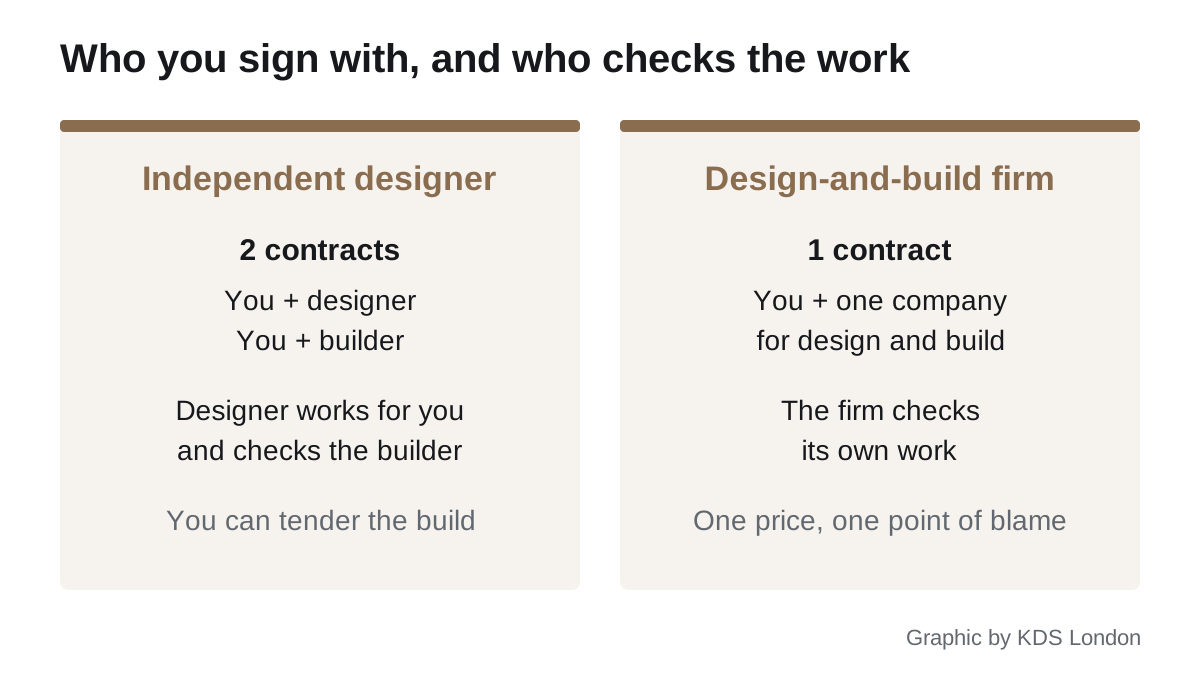
Design and build vs interior designer is really a question about who is on your side once the builders arrive. A design-and-build firm designs your project and then builds it, under one contract and one price. An independent interior designer designs it, helps you appoint a separate builder, and then checks that builder’s work on your behalf. Both can produce a beautiful kitchen or a whole-house refurbishment in London. They put the risk, and the control, in different places.
Neither is better across the board. This page sets out how each one works, where each goes wrong, and a simple test for which suits your project.
How a design-and-build firm works
You sign one contract with one company. It surveys the house, produces the design, prices the build, employs or subcontracts the trades, and hands over the finished rooms. Many London kitchen showrooms, bathroom companies and refurbishment firms work this way, as do most loft and extension specialists.
What that gives you:
- One price early. The firm prices its own design, so you know the build cost before you are deep into drawings.
- One point of contact. If a tile is wrong or a socket is in the wrong place, there is no argument about whether the designer or the builder is at fault. It is the firm’s problem.
- Speed. Design and build can overlap, because the firm does not need to issue drawings for other builders to price.
- Less for you to run. No tender, no second contract, no chasing two parties.
How an independent interior designer works
You appoint the designer under one agreement and a builder under another. The designer produces the brief, concept, detailed drawings and specification, often helps you find and compare two or three builders, and then visits site to check the work matches the design. Our page on the interior design process walks through each stage.
What that gives you:
- Someone on your side. The designer is paid by you, not out of the build price, so they can push back on a builder who cuts corners or prices extras.
- A competitive build price. With full drawings and a specification, builders price the same job, and you can compare like for like.
- Wider choice of products. An independent designer is not tied to one supplier’s kitchens, tiles or joinery. Our page on designer trade discounts explains how buying through them works.
- Design that is not shaped by what is easy to build. A firm that builds what it draws has an incentive to draw what it builds most efficiently.
Where each one goes wrong
Design and build: the firm marks its own homework. Nobody independent checks the work unless you pay for it. The design can drift towards the firm’s standard details and preferred suppliers, and a quoted price can hide allowances (provisional sums) that turn into extras later. Ask for every provisional sum in writing, with what happens if it is exceeded.
Independent designer: the gap between two contracts. If something goes wrong, the designer may say the builder did not follow the drawings and the builder may say the drawings were unclear. You need a clear specification and a builder contract that refers to it. The overall programme can also run longer, because the design must be largely finished before builders can price it, and you pay two sets of fees.
The contracts to ask for
For a design-and-build job on your own home, ask what contract the firm uses and read it before you sign. Many use their own terms; some use a standard form.
With an independent designer, the Joint Contracts Tribunal publishes contracts written for homeowners. Its Building Contract and Consultancy Agreement for a Home Owner/Occupier (HO/C and HO/CA) is designed for the case where you have appointed a consultant to oversee the builder, and pairs the builder’s contract with an agreement for the consultant. The simpler HO/B is for homeowners dealing with a builder directly. Our interior design contract guide covers the clauses worth checking in the designer’s own agreement.
Building regulations: who carries the duties
Since 1 October 2023, building work in England has named dutyholders under Part 2A of the Building Regulations 2010, including a principal designer and a principal contractor where more than one contractor is involved. As a homeowner you are a domestic client, and your client duties pass to the principal designer or principal contractor (or the sole designer or contractor) rather than staying with you.
In practice:
- Design and build: the firm usually takes both roles. One company is responsible for the design and the build complying.
- Independent designer plus builder: check who is principal designer for building regulations purposes. An interior designer who is only choosing finishes and furniture may not be the right person for structural or layout changes; an architect or the builder may need to take that role. Our page on designer vs decorator vs architect explains who does what.
Cosmetic work, such as decoration and loose furniture, does not involve building regulations at all. Moving walls, drainage, electrics and windows usually does.
Which one suits your project
| Your situation | Usually better fit |
|---|---|
| One room, mostly standard fittings, a firm whose past jobs you like | Design and build |
| You want one price and one person to blame | Design and build |
| Extension or loft where the build is most of the job | Design and build (or architect plus builder) |
| Whole-house refurbishment with bespoke joinery and a long spec | Independent designer |
| You want builders to compete on price | Independent designer |
| You want furniture, lighting and finishes from many suppliers | Independent designer |
| You live away or cannot visit site often | Either, but pay for independent site checks |
A middle route is common in London: a design-and-build firm for the structural work, with an independent designer appointed by you for the interiors, joinery and furnishing. If you do this, agree in writing where one scope ends and the other begins.
Before you sign with either
- Write a brief with your total budget, including furniture. Our interior design brief guide has a template.
- Ask both types for two or three recent London projects you can visit or call the owner about. Our page on how to vet an interior designer lists the checks.
- Get the fee basis in writing: fixed, hourly or a percentage, and any mark-up on products. Our interior designer fees explained page shows how each one works.
- For design and build, ask for a breakdown of the price and every provisional sum. For an independent designer, ask how many site visits are included.
Frequently asked questions
What is the difference between design and build and an interior designer? A design-and-build firm designs and builds your project under one contract. An independent interior designer only designs it and oversees a separate builder that you employ directly, so you hold two contracts.
Is design and build cheaper than hiring an interior designer? Not always. You avoid a separate design fee, but the design cost is built into the firm’s price, and you cannot put the build out to competing builders. On larger projects, competitive tendering from a full specification can save more than the designer costs.
Who checks the builder’s work on a design-and-build project? The firm checks its own work, along with building control for regulated items. If you want an independent check, you can pay a designer, surveyor or architect to visit site for you.
Can an interior designer manage builders? Many full-service designers do, visiting site and checking the work against their drawings. Confirm in writing how many visits are included and whether they act as contract administrator.
Who is responsible for building regulations on my renovation? As a domestic client in England, your duties pass to the principal designer and principal contractor, or the sole designer or contractor. On a design-and-build job that is usually the firm. With a separate designer and builder, agree who holds each role before work starts.
Can I use a design-and-build firm and an interior designer together? Yes. A common London approach is a design-and-build firm for the structural work and an independent designer for interiors and joinery. Set out in writing where each scope starts and stops.
The Folio
Want more like this in your inbox?
One considered idea for your London home, every Thursday.
SubscribeMore from KDS London
All guides
How Much Does an Interior Designer Cost in London in 2026?
What interior designers charge in London in 2026: hourly rates, day rates, per-room fees and percentage models, with real figures and what each one buys you.
Read
Navy Kitchen Ideas: Blue, Teal and Cobalt Cabinet Designs
Navy kitchen ideas that work: the best blue cabinet shades, worktop and hardware pairings, and how to use navy, teal and cobalt without dating the room.
Read
Gold and Brass Bathroom Accessories: How to Style Warm Metallics
How to choose and style gold bathroom accessories and brass fittings, from brushed vs polished finishes to mixing metals and avoiding tarnish.
Read